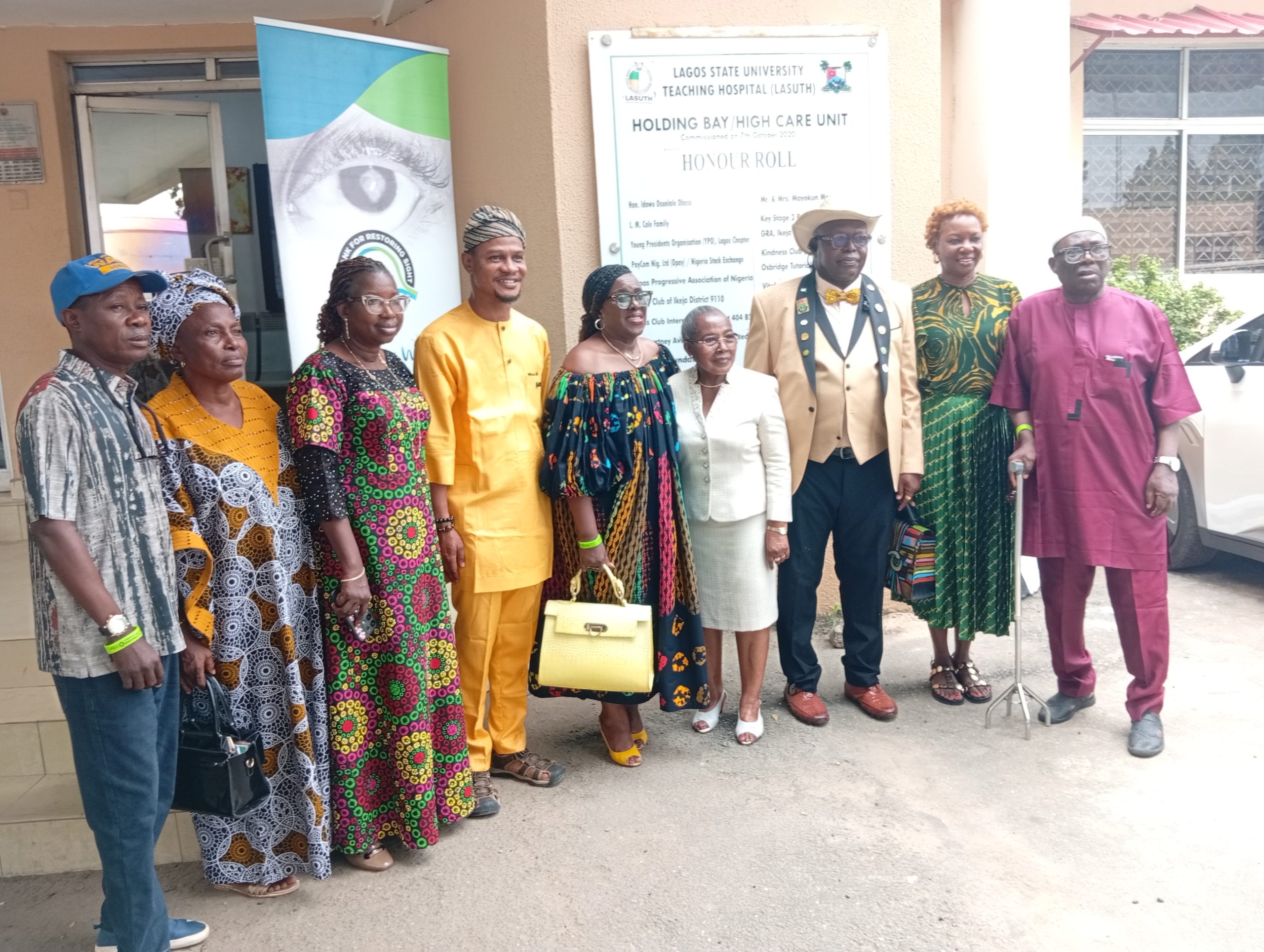

.......unveils actress Joke Silva as its new brand ambassador.
The Eye Bank for Restoring Sight Nigeria says a shortage of donated corneas is limiting access to sight-restoring surgery, as it unveils actress Joke Silva as its new brand ambassador.
More than 200 people are currently waiting for corneal transplants in Nigeria, according to the Eye Bank for Restoring Sight Nigeria, which is calling for more Nigerians to pledge their corneas for donation after death.
The organisation says the shortage of donor corneas remains one of the biggest obstacles to restoring sight to people whose blindness results from damage or scarring of the cornea.
The call was made in Lagos on Thursday, 20 August, during the unveiling of actress and broadcaster Joke Silva as the Eye Bank's brand ambassador.
The Eye Bank says it does not perform the transplant itself. Its role is to facilitate the harvesting, processing, storage and distribution of donor corneal tissue to surgeons who carry out the procedures.
Why cornea donation matters
The cornea is the transparent tissue at the front of the eye. When it becomes severely damaged or opaque, a transplant can restore sight in some patients.
Dr Mosunmade Faderin, the Eye Bank's medical director, said the organisation wants to increase the supply of donated corneas so that more Nigerians with corneal blindness can benefit from transplantation.
She said the organisation's work involves "the continuous process of harvesting, processing and storage of corneas" to help people regain their sight through corneal grafting, also known as keratoplasty.
She stressed that donating a cornea does not mean removing the entire eye."We are not taking out the whole eye," she said, explaining that the cornea is the clear part at the front of the eye that can be used for transplantation.
The organisation says public misconceptions and cultural attitudes towards the removal of body tissue after death continue to discourage potential donors.
Faderin said some people fear being stigmatised because they have received tissue from another person.
"Most of our patients that have had corneal transplant, they don't want to come forward," she said.
A shortage that has persisted for years
The Eye Bank's latest waiting-list figure shows that the problem has not been resolved despite years of advocacy.
In 2016, the organisation said more than 160 people were waiting for corneal transplants. At the time, it also reported that it had performed 98 successful corneal operations and had relied on imported corneas to address shortages.
The current figure of more than 200 patients is not directly comparable with the 2016 figure because the waiting lists were recorded at different times and may have been compiled under different conditions.
It does, however, show that the shortage remains a significant challenge.The Eye Bank was established in 2004 as a joint project of the Ophthalmological Society of Nigeria and the Federal Nigeria Society for the Blind.
Its initial funding came from proceeds generated after the monetisation of gifts from the 75th birthday celebration of Chief Olaseinde Eniola Akinsete in 2003.
The organisation operates within a legal framework that includes Nigeria's Corneal Grafting Act of 1973.
The Act allows the eyes of deceased people to be used for therapeutic purposes where the required consent has been given.
The National Health Act 2014 also provides for the donation of human bodies and specified tissues after death.
Section 55 allows a competent person to make such a donation through a will, a signed document witnessed by at least two competent people, or a written statement made in the presence of at least two witnesses.
The law also restricts the purposes for which donated tissue can be used, including therapy and health-related research.
Recipients show what is at stake
For people who receive a suitable transplant, the difference can be profound.Pa Oguntibeju, one of the recipients who spoke at the event, said he underwent a corneal transplant in 2022 after years of serious problems with his eye.
Before the procedure, he said he struggled with basic activities and could not see well enough to feed himself or use the toilet without assistance.
"The same day they did it was that day I started seeing," he said.He said he can now read his Bible, eat without assistance and move around independently."I can even read my Bible," he said.
"I can eat myself... then go to toilet myself. Nobody is assisting me to do everything."Oguntibeju said the experience convinced him that Nigeria needs stronger local capacity for corneal transplantation.
"If such thing has been existing in this country, I don't need to go to India," he said.
His account illustrates the potential benefit of increasing the supply of locally available donor tissue, although transplantation remains dependent on suitable patients, qualified surgeons, medical facilities and successful post-operative care.
Families can make the decision possible
The event also featured the story of a family that agreed to honour a relative's wish to donate his cornea after death.
Lion Kunle Shodipo said his late brother had expressed his intention to donate his cornea.

He said the family initially had to navigate legal and emotional concerns before the donation could proceed.
Shodipo recalled accompanying his late brother's corpse to the theatre after the necessary clearance had been obtained.
He said he had expected doctors to remove the entire eyeball but discovered that only the required tissue was taken.
"I thought he wanted to remove the whole eyeball. But he said this is the only thing they needed," he recalled.
Shodipo said the family later met people who had benefited from the donated tissue.
He argued that such experiences could help challenge misconceptions surrounding corneal donation.
"If I happen to be a recipient, I will not be ashamed," he said, urging people to speak openly about donation and transplantation.
'Part of her is living'
Fola Akande, vice-chairman of the Eye Bank and a cornea donor, described her family's experience after her mother died suddenly in 2012.
She said her mother was 83 and had been active in church shortly before her death.
Akande said her father, an ophthalmologist and one of the Eye Bank's founding figures, contacted Faderin because the corneas needed to be harvested promptly.
"To the glory of God, even though it was very emotional, because it was sudden, Dr Faderin has mentioned, we harvested her cornea, and the recipients can see today," she said.
Akande said the experience changed how her family viewed donation."All of us in the family, we are all donors," she said.
Her account also challenges the assumption that an older person's corneas cannot be used. She said her mother's corneas were suitable for donation despite her age.
Joke Silva urges Nigerians to look inward

Joke Silva, who accepted the role of brand ambassador, said she wanted to use her public profile to support awareness about corneal donation.
She said her background had exposed her to medicine and public health, but stressed that people outside the medical profession could also contribute to improving healthcare.
For Silva, the issue is also about Nigeria developing its own capacity instead of relying on other countries.
"The time has come for all of us to do what we can do," she said.She added: "Nigeria does what Nigeria can do for Nigeria.
"Silva described corneal donation as a form of giving that does not require a person to surrender anything while alive.
"It doesn't cost you anything," she said, referring to donation after death.
Her comments reflect one of the Eye Bank's central arguments: tissue that can no longer serve the deceased can potentially restore sight to someone living with corneal blindness.
Groups Urge Tinubu to Reject Nigeria Tobacco Control Amendment Bill
The challenge is not simply awareness
The Eye Bank says it has conducted outreach programmes involving churches, clubs, community organisations and professional groups to explain corneal donation.But awareness alone may not solve the problem.
The organisation also needs sustained funding, a reliable donor pool, suitable tissue-processing and storage capacity, surgeons and facilities capable of performing grafts, and a system that can move donated tissue quickly to appropriate recipients.
Dr Festus Odunayo Oshoba, chairman of the Eye Bank's Board of Governors, said the organisation needed to persuade Nigerians that organ and tissue donation can benefit people they know.
"We need to talk to our people and let them know that somebody that you know may be the beneficiary of that organ that you are donating," he said.
He also urged Nigerians not to allow the country to fall behind other parts of the world in organ donation.
"We also have to know that all over the world this is what is being done and we should not be left behind," he said.
Representing the Chief Medical Director of the Lagos State University Teaching Hospital, Prof Adetokunbo Fabamwo, Dr Bamidele Ayodele described healthcare as a shared responsibility."

Health is a collective responsibility, everyone has to contribute their own quota," he said.
What happens next?
The immediate task for the Eye Bank is to expand its donor base while addressing the concerns that discourage families from consenting to tissue donation.
Its campaign will also have to distinguish clearly between corneal blindness and other causes of blindness.
A corneal graft cannot restore sight where the underlying damage affects other parts of the visual system.
The organisation's own history shows that awareness campaigns have been running for years.
Earlier campaigns also highlighted the shortage of donor tissue and the need for Nigerians to consider donation after death.
The new ambassadorial campaign therefore faces a familiar test: whether public advocacy can translate into more legally valid pledges, more actual donations after death and, ultimately, shorter waiting times for patients.
For the more than 200 people currently waiting, the value of that effort is measured not in publicity but in whether a suitable donated cornea becomes available when they need it.