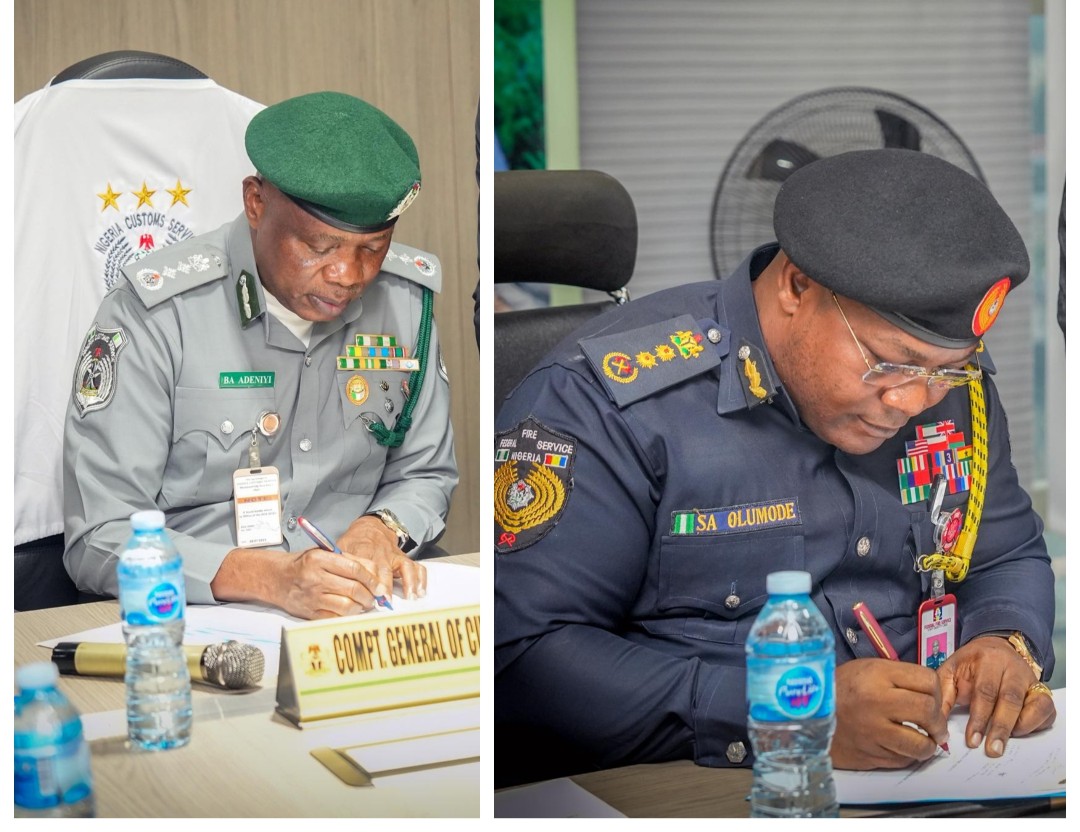

The Nigeria Customs Service (NCS) has signed separate agreements with the Federal Fire Service (FFS) and Unilever Nigeria PLC aimed at improving fire safety, tackling counterfeit goods and strengthening cooperation with businesses involved in international trade.
The agreements were signed on Thursday, 27 August 2026, at the NCS headquarters in Abuja.
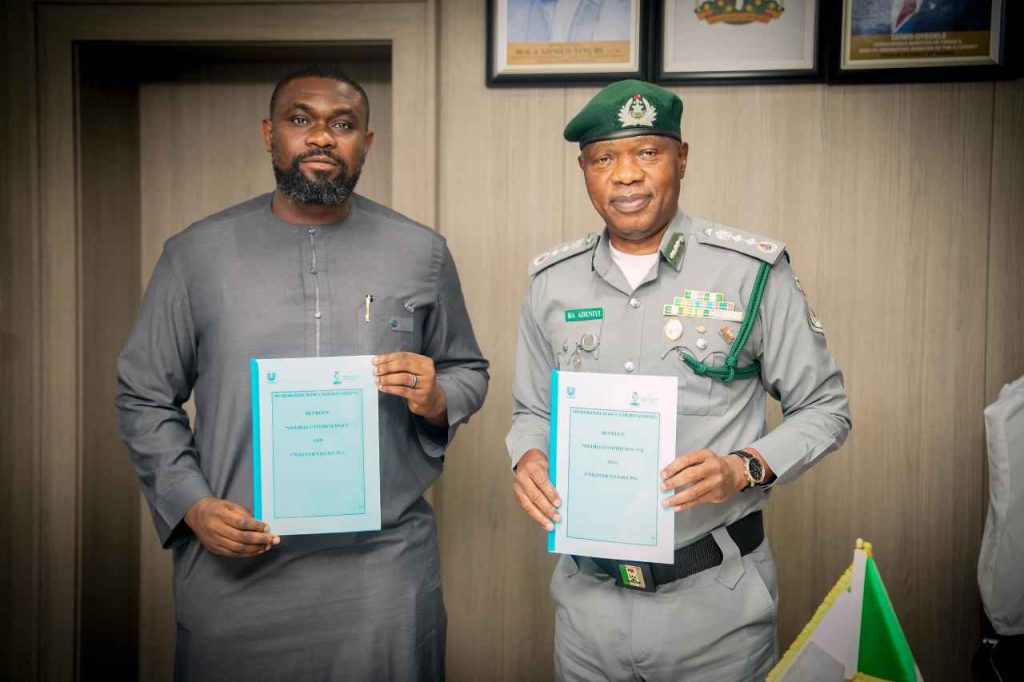
The deal with the Federal Fire Service focuses on fire prevention and emergency response at Customs facilities, while the agreement with Unilever is intended to improve information sharing around trademarks, product identification and suspected counterfeit goods.
The agreements come as Customs expands its use of digital systems and its Authorised Economic Operator (AEO) programme to make legitimate trade easier while strengthening compliance and enforcement.
What the Customs-Fire Service agreement means
Under the agreement with the Federal Fire Service, the two agencies plan to work together on fire safety standards, emergency response, training and information sharing.
Customs Comptroller-General Adewale Adeniyi said the agreement was intended to protect personnel, government property and other critical assets.
“I am very confident that this MoU will translate to practical actions that save lives, protect government assets, and enhance our collective capacity to respond to emergencies,” Adeniyi said.
The Controller-General of the Federal Fire Service, Olumode Adeyemi, described the agreement as the first strong MoU between the Fire Service and a sister agency and said the FFS would deploy its capacity to protect Customs personnel and assets.
The FFS and Customs have not publicly provided details of the number of facilities covered by the agreement, the funding arrangements or a timetable for implementing the planned fire-safety measures.
Those details will matter in determining whether the agreement produces practical improvements beyond the signing ceremony.
Also Read: Police Rescue Two-Year-Old Boy in Alleged Staged Kidnapping Case
Why the Unilever agreement matters
The separate agreement with Unilever focuses on a different problem: the movement of counterfeit products through the supply chain.
Customs says the partnership will create a structured channel for exchanging information about trademarks, packaging, product samples and other features that can help officers identify suspected counterfeit goods.
Adeniyi said closer engagement with businesses could also provide information that influences Customs policy and operational decisions.
“Some of the takeaways we get from these engagements with the private sector influence the policies and decisions that we take,” he stated.
The arrangement could help Customs officers distinguish genuine products from imitations at ports and other points of entry.
For consumers, the issue goes beyond lost sales for manufacturers.
Counterfeit goods can affect product quality and safety, depending on what is being copied.
For legitimate manufacturers, effective enforcement could also reduce competition from businesses that avoid the costs associated with producing and distributing genuine products.
However, the MoU itself does not establish how many counterfeit shipments will be targeted, how quickly information will be exchanged or how success will be measured.
Customs' wider trade reforms
The agreements form part of a broader push by the NCS towards collaboration, digitalisation and risk-based trade facilitation.
Customs launched its Authorised Economic Operator programme in February 2025 as a system for giving compliant businesses benefits such as faster clearance and fewer physical inspections.
The programme is aligned with World Customs Organisation standards.
The NCS says the programme is designed to reward businesses with strong compliance and secure supply chains.
Its current AEO platform lists benefits including faster cargo release, priority handling and dedicated Customs support for qualifying operators.
The agency has also moved from the former Fast Track Scheme to the AEO framework.
Customs announced in August 2025 that the Fast Track Scheme would be decommissioned from 31 December 2025, with beneficiaries required to migrate to the new programme.
The change reflects a wider attempt to move from blanket facilitation towards systems that give greater benefits to traders judged to have strong compliance records.
Customs reported in February 2026 that its AEO programme had generated an additional ₦362.79bn in revenue among 51 certified entities as of 27 October 2025, although that figure is a Customs claim and does not by itself establish that the programme caused all of the reported increase.
What Unilever says about its contribution
Unilever Nigeria managing director Tobi Adeniyi said the company had operated in Nigeria since 1923 and had localised more than 70% of its raw materials.
He also said the company supported about 15,000 direct and indirect jobs.
Those figures should be treated with some caution because Unilever's published 2025 reports give different figures.
Its 2025 annual report says more than 60% of its raw materials were sourced locally and says its activities had impacted more than 10,000 jobs across the value chain.
Its 2025 sustainability report similarly reports more than 60% localised raw materials and more than 10,000 jobs across the value chain.
The difference may reflect a change in measurement, a later update or different definitions of employment and local sourcing.
The company would need to clarify the basis for the newer 70% and 15,000 figures cited at the MoU signing.
Tobi Adeniyi also praised Customs' digitalisation and its AEO programme.
He said previous engagements between the company and Customs had produced practical results, including lessons from training involving more than 70 Customs officers.
He reaffirmed Unilever's intention to work with Customs against counterfeiting and illicit trade and to expand the relationship through further engagements.
What happens next?
The value of the three-way development will ultimately depend on implementation rather than the signing of the agreements.
For the Fire Service partnership, readers will want to know whether Customs facilities will receive new fire-prevention equipment, trained personnel, fire stations and clearly defined emergency-response arrangements.
For the Unilever partnership, the key test will be whether better product information and intelligence sharing lead to more effective detection of counterfeit goods without creating unnecessary delays for legitimate traders.
The agreements also raise an accountability question: both agencies and the company will need to show what measurable results emerge from the partnerships.
For now, the MoUs establish a framework for cooperation.
The next stage is to see whether that framework produces safer Customs facilities, more effective action against counterfeit products and smoother treatment for legitimate trade.