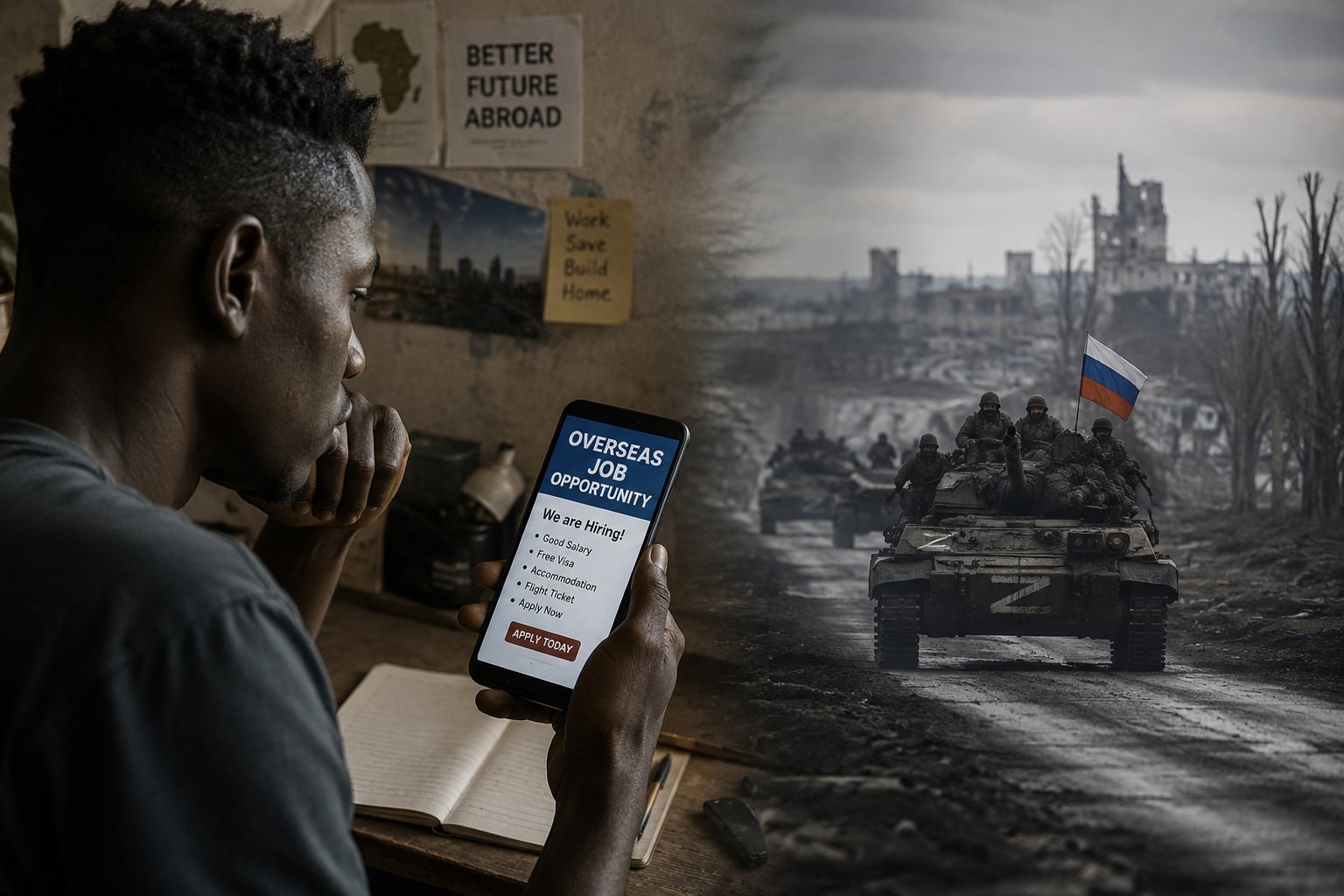

......New evidence from Ghana, Nigeria and international investigations suggests that Russia's recruitment of foreign nationals has grown into a global network, with some Africans allegedly lured by jobs, education and residency promises before ending up in combat.
For Nigerian families whose relatives travelled to Russia looking for work, the journey has sometimes ended with a phone call from a battlefield, a prisoner-of-war camp or no news at all.
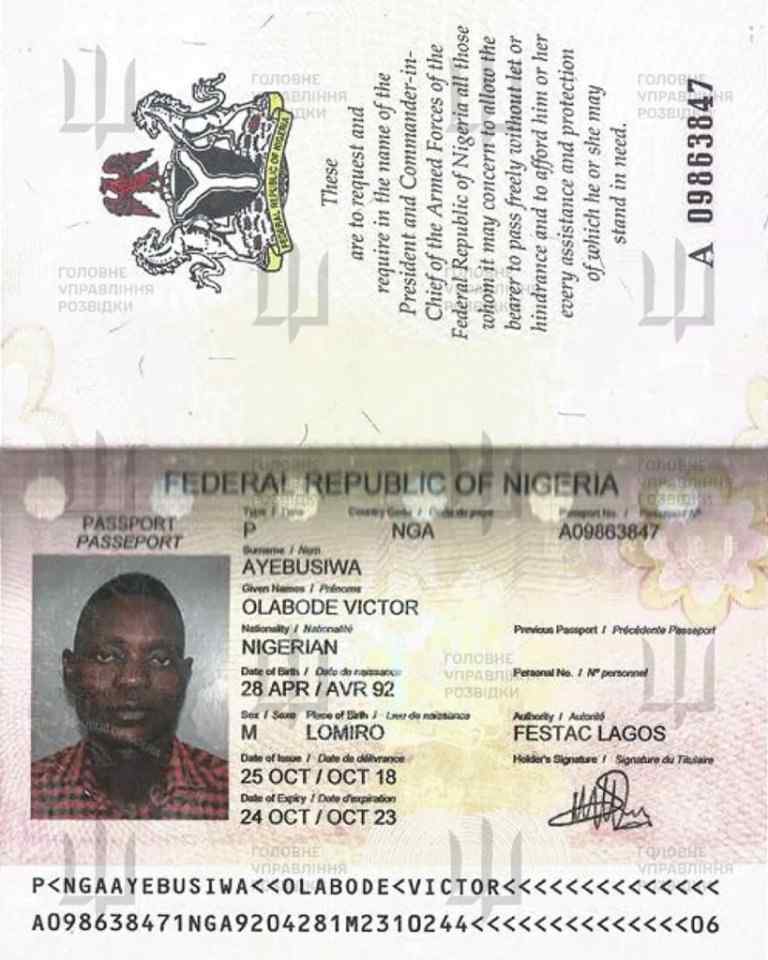
The death of Nigerian Olabode Victor Ayebusiwa in Ukraine was one such case.
But months after his death was reported, new evidence suggests his story was not an isolated incident.
Ghana says 62 of its citizens have now been killed in the Russia-Ukraine war, while 15 others remain missing.
Ghanaian Foreign Minister Samuel Okudzeto Ablakwa disclosed the figures after talks with Russian Foreign Minister Sergei Lavrov in Moscow this month.
The Ghanaian government says some young people were lured to Russia with promises of employment before being enlisted to fight.
Mr Ablakwa said Russia had pledged to work with Ghana to stop what Accra describes as illegal recruitment.
"This is not our war, and it should not be claiming Ghanaian lives,” he said.
The figures provide a fresh indication of the scale of the problem across Africa.
What happened to Olabode Ayebusiwa?
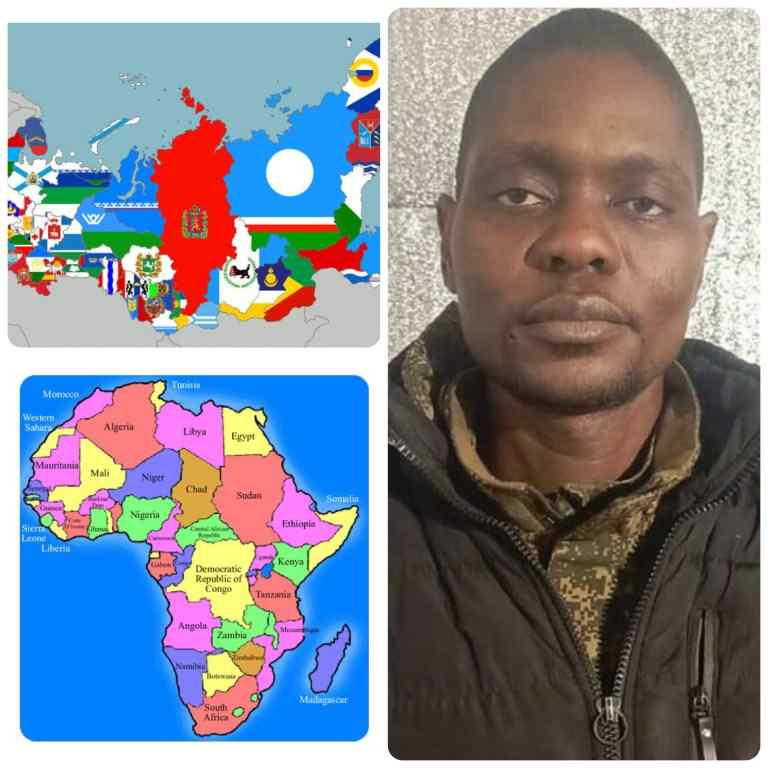
Ayebusiwa, who was from Ilutitun in Ondo State, was identified by Ukraine's Defence Intelligence as a Nigerian killed while fighting for Russian forces in the Kharkiv region.
Ukrainian authorities said he signed a military contract in late February 2026, shortly after Nigeria warned citizens against illegal recruitment into foreign armed conflicts.
Ukraine said Ayebusiwa was killed near Hrafske in the Kharkiv region.
His case is particularly significant because Nigeria's warning came before he signed the reported contract.
That raises a difficult question for Nigerian authorities: what happened between the government's warning and the recruitment of another Nigerian?
Ukraine's Defence Intelligence has described Ayebusiwa's recruitment as involving deception and promises of easy money.
Those allegations have not been independently established in every detail.
Russia has also rejected claims that it operates a government-backed scheme to deceive Nigerians into joining its armed forces.
Russian Ambassador to Nigeria Andrey Podyelyshev said in February that there was no government-supported programme to recruit Nigerians to fight in Ukraine.
The dispute over how recruits enter the Russian military is therefore central to the story.
Nigeria warned its citizens
On 15 February, Nigeria's Ministry of Foreign Affairs issued a formal warning about the recruitment of Nigerians into foreign armed conflicts.
The ministry said Nigerians had allegedly been targeted with offers of lucrative employment, security jobs, education and migration opportunities.
It also said some recruits were allegedly pressured into signing military contracts after arriving abroad.
The government warned that Nigerians who participate unlawfully in foreign conflicts do so at their own risk.
But the warning has not stopped reports of new cases.
In February, Nigerian Abubakar Adamu appealed to the Federal Government for help after alleging that he travelled to Russia on a tourist visa expecting to work as a security guard.
His lawyers said his travel documents were confiscated after he arrived and that he was made to sign military papers written in Russian.
Adamu said he later discovered that he had been enlisted into the Russian army and refused deployment to Ukraine.
His case remains an allegation, but it provides a concrete example of the recruitment method Nigerian officials have warned about.
More Nigerians are caught in the system
Other Nigerian cases have emerged since the original reports about Ayebusiwa.
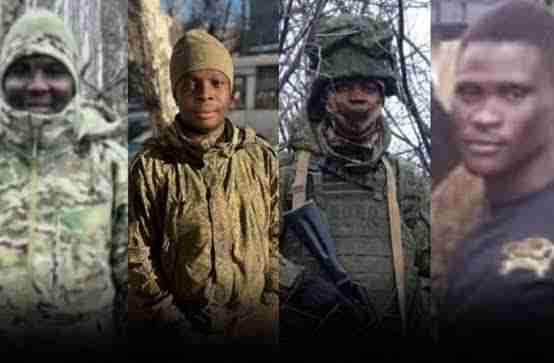
Ukrainian sources have identified Nigerian nationals who were captured while serving with Russian forces.
Adisa Ridwan Balogun, for example, has been listed as a Nigerian prisoner of war in Ukraine since December 2025.
Matthew Sunday Bankole has also been listed as a Nigerian prisoner of war since November 2025.
Their cases matter because they show that the consequences of foreign recruitment are not limited to deaths.
Some recruits become prisoners of war.
Others disappear.
Families can spend months trying to establish whether relatives are alive, detained or dead.
And where recruitment takes place through informal agents, social media accounts or intermediaries, it can be difficult for governments to identify who arranged the journey.
The scale may be much larger
A major investigation published in April by the International Federation for Human Rights, Truth Hounds and the Kazakhstan International Bureau for Human Rights and Rule of Law estimated that Russia had recruited at least 27,000 foreign nationals from more than 130 countries since the full-scale invasion began in 2022.
The organisations said the recruitment extended beyond voluntary military enlistment and included cases in which people were allegedly deceived or coerced.
The figure has not been independently verified by all governments involved.
But it is broadly consistent with evidence from several countries.
Ukraine's Foreign Ministry said in May that at least 2,965 citizens from 36 African countries had served or were serving in the Russian army in the war against Ukraine.
It said the real number could be higher.
Nigeria, Ghana, Cameroon, Kenya and Uganda were among the main African source countries identified by Ukrainian officials.
A recruitment network built around the internet
The recruitment process is increasingly moving online.
A European External Action Service investigation published in August identified what it described as a coordinated digital infrastructure involving recruitment websites, advertisements and intermediaries operating across several continents.
The investigation found networks using apparently civilian employment brands and social-media channels to attract foreigners.
The method is straightforward.
A person searching for work abroad sees an advertisement offering good pay, accommodation or a route to Russian residency.
The advertisement may say little or nothing about military service.
After the person arrives in Russia, the circumstances can change.
Investigators and affected recruits have alleged that some are then pressured to sign military contracts or are directed towards military-related work.
That makes the first stage of the journey particularly difficult to police.
The initial advertisement may look like an ordinary employment opportunity.
The Russian Houses questionAnother development has widened the debate.
Ukrainian intelligence has alleged that Russia's network of so-called Russian Houses in Africa can help create a pipeline through which young Africans are exposed to Russian education, language programmes and employment opportunities before some are drawn into the country's war effort.
The allegation is disputed and comes from a Ukrainian intelligence service, so it requires independent verification.
But investigators say the network is important because it shows how recruitment may operate beyond conventional military advertising.Ukraine says Russia has been expanding such centres across Africa.
It has also alleged that some centres have links to broader Russian influence operations.
That does not mean that everyone who attends a Russian cultural or educational programme is a potential military recruit.
But it highlights the challenge for governments trying to distinguish legitimate educational migration from recruitment activity.
Britain has imposed sanctions
The concern has also reached the level of international sanctions.
In May, Britain sanctioned Russian national Polina Alexandrovna Azarnykh under its Global Irregular Migration and Trafficking in Persons sanctions regime.
The British government accused her of facilitating the movement of people from countries including Nigeria, Egypt, Iraq, Morocco, Syria, Yemen and Côte d'Ivoire through Russia to Ukraine, where they were allegedly deployed to fight for Russian forces.
The sanctions included an asset freeze, travel ban and director disqualification.
The British government said the individuals involved were allegedly deployed with minimal training and under harsh conditions.
These are allegations made by the UK government and should not be treated as proof that every person travelling through the network was deceived.
But the sanctions represent a significant escalation because they formally identify alleged recruitment for the war as part of a wider irregular-migration and trafficking problem.
The problem is no longer only about men
The latest Nigerian evidence also shows that the recruitment problem may extend beyond people being sent directly to the battlefield.
In August, ActionAid Nigeria called for an investigation into reports that young Nigerian women had been recruited to Russia through the Alabuga Start programme with promises of education, professional training and well-paid employment.
The organisation said some participants were allegedly exposed to unsafe working conditions and military drone production.
The allegations concern work linked to Russia's military-industrial system rather than direct enlistment as soldiers.
That distinction matters.
A person does not necessarily have to carry a weapon to become part of a war economy.
For Nigeria, the issue therefore extends beyond mercenary recruitment to the wider question of how young people are recruited for overseas employment and what safeguards exist once they leave the country.
Also Read: Police Arrest Two Doctors, Two Others Over Alleged Organ-Harvesting Network in Nasarawa
Cameroon offers another warning
Cameroon has also formally acknowledged the deaths of 16 citizens who were fighting for Russia.
The country's foreign ministry urged relatives of the dead to contact officials but did not disclose how the men were recruited or where they died.
Cameroon had previously warned military personnel against leaving the country to fight in Ukraine.
The lack of detailed information illustrates one of the biggest obstacles in establishing the true scale of African involvement.
There is no single public database covering all African nationals who have joined Russian forces.
Governments may have incomplete information.
Families may not know where relatives are.
And battlefield deaths can take months to verify.
Why would young Africans take the risk?
The answer is partly economic.
A well-paid overseas job can appear attractive to someone facing unemployment, rising living costs and limited opportunities at home.
Recruiters can exploit that pressure.
A promised salary, Russian residency or a chance to study abroad may appear more tangible than the risks of an unfamiliar war.
A Lagos-based migration researcher told Hope Newspaper: “The pattern is deeply disturbing. Young Africans facing economic frustration are easy targets for international recruitment networks. Some are promised jobs and residency opportunities only to end up in active combat zones.”
The vulnerability does not mean every African who joins the Russian army was deceived.
Some foreigners knowingly sign military contracts.
That distinction is important when assessing the evidence.
The central concern is whether recruiters deliberately conceal the military nature of the opportunity or use coercion after recruits arrive.
Is this human trafficking?
Human rights organisations say some cases could meet the characteristics of trafficking.
The FIDH-led report argued that deception, exploitation and coercion may amount to trafficking in some circumstances.
FIDH President Alexis Deswaef said that, regardless of the circumstances surrounding recruitment, many foreign nationals were later sent to some of the most dangerous positions on the battlefield.
The report argues that some cases could potentially fall within international definitions of human trafficking.
But that legal conclusion cannot automatically apply to every foreign recruit.
International law distinguishes between voluntary enlistment and recruitment involving deception, coercion or exploitation.
Establishing which category applies requires evidence from individual cases.
What Russia says
Moscow rejects the broader allegation that it is systematically deceiving foreigners into fighting.
Russian officials have maintained that foreign nationals serving with Russian forces enter into military contracts voluntarily.
The Russian ambassador to Nigeria has also denied the existence of a government-supported programme to recruit Nigerians specifically for the war.
The Russian position creates an important test for future investigations.
If the recruits entered voluntarily, governments will need evidence showing that.
If recruiters misled or coerced them, authorities will need to identify who organised the recruitment and how the system operated.
Either way, individual cases need to be independently documented.
Ghana's new move changes the picture
Ghana's latest diplomatic intervention may offer a possible model for Nigeria.
After reporting that 62 citizens had died and 15 remained missing, Accra raised the issue directly with Moscow.
Russia, according to Ghana's foreign minister, agreed to work with Ghana to stop the illegal recruitment of its citizens.
The important question is what that pledge will produce in practice.
Will Russia investigate recruiters?
Will Ghana receive information about its missing citizens?
Will families receive official confirmation of deaths?
And will recruitment advertisements targeting Ghanaians be removed?
Nigeria faces similar questions.
What should happen next?
The Nigerian government has already warned citizens.
The next stage should be more than another warning.
Authorities need to identify recruitment agents operating from Nigeria, investigate travel intermediaries involved in suspicious schemes and establish whether Nigerian citizens have been recruited through particular companies or online networks.
Embassies and consulates also need reliable systems for identifying Nigerians who become stranded or detained after travelling to Russia.
Families need a clear channel for reporting missing relatives.
Young Nigerians need to know how to verify foreign employment offers before paying agents or surrendering their passports.
And recruitment companies sending Nigerians abroad need stronger scrutiny.
Why this matters
For Russia, foreign recruits provide another source of manpower for a war that has imposed enormous personnel demands.
For recruiters, vulnerable migrants can represent a lucrative pool of potential workers or soldiers.
For African governments, the cost can be measured in deaths, prisoners, missing citizens and families left without answers.
For young Africans, the danger is more immediate.
A job advertisement can become a military contract.
A student visa can lead to a military environment.
And an overseas opportunity can end in a battlefield thousands of kilometres from home.
That is the central lesson from Ayebusiwa's death.
His case began with a Nigerian looking for an opportunity abroad.
The wider investigation now suggests that governments across Africa face a bigger question: how do they protect citizens who leave home in search of a better life when the line between migration, employment and military recruitment becomes deliberately blurred?
For Nigeria, the next test will not be another warning.
It will be whether the government can identify the networks behind the recruitment, account for Nigerians already caught in the system and prevent another family from learning about a loved one's death from a foreign battlefield report.


Abiodun Jonpo
Any Africa fighting Russian is playing with death and that’s fact