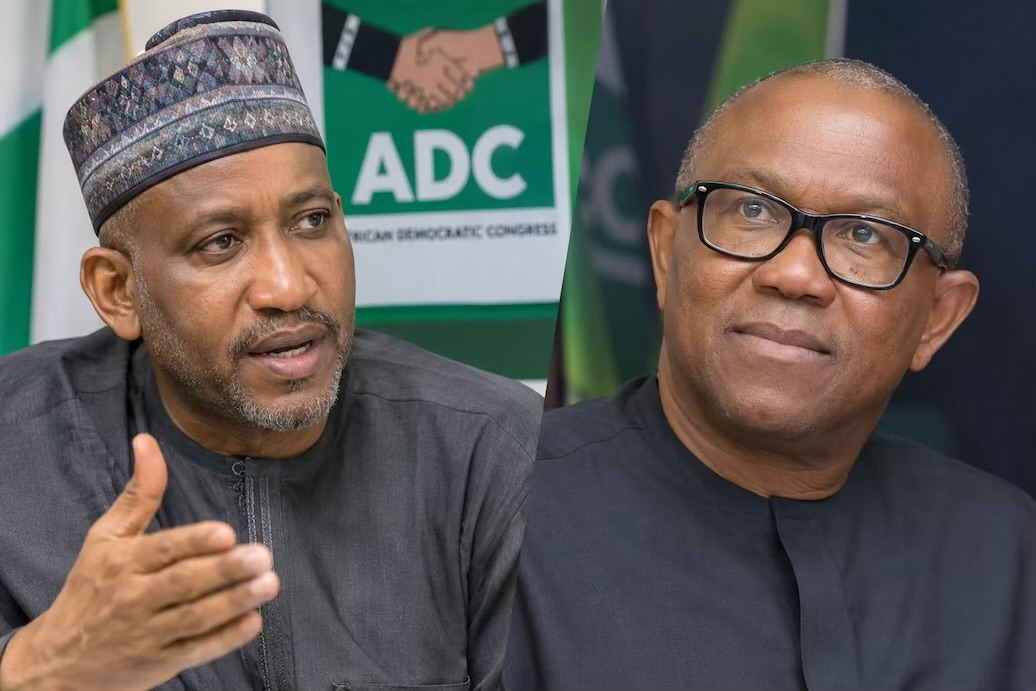

Former Labour Party vice-presidential candidate, Datti Baba-Ahmed says he warned Peter Obi against joining the African Democratic Congress (ADC), arguing that the former Anambra governor’s subsequent exit from the party vindicated his concerns.
Baba-Ahmed, who was Obi’s running mate in the 2023 presidential election, said he personally approached Obi at the Yar’Adua Centre before he joined the opposition coalition.
Speaking on the Mic On Podcast, he said he told Obi that the ADC was not the right political platform for him.
“When he was going to join ADC, I had to go to Eraduwa Centre ahead of him, call him aside,” Baba-Ahmed said.
“They were worried. Why is that you’re calling PTOB aside and talking to him? And I told him, this is the last time I’m coming to this place. But you, I want to tell you one, two, three, four.”
“I gave him my reasons. This is not a place for you. Was I proven wrong? I was proven right.”
Baba-Ahmed then pointed to Obi’s departure from the ADC as evidence for his argument.
“Within four months, PTOB left ADC. Now, I don’t like people who contradict themselves.”
Why Obi left the ADC
Obi formally joined the ADC in December 2025 after leaving the Labour Party and later registered with the party in Anambra State in March 2026.
He announced his decision to leave the ADC in May, citing what he described as a worsening political environment, including internal crises, external interference and hostility within political structures.
Obi subsequently moved to the Nigeria Democratic Congress, where he emerged as the party’s presidential candidate for the 2027 election. Atiku Abubakar is now the presidential candidate of the ADC.
Baba-Ahmed’s comments therefore come against the background of a significant political realignment among opposition politicians ahead of the 2027 presidential election.
From running mates to separate political paths
The disagreement is notable because Baba-Ahmed and Obi campaigned together on the Labour Party ticket in 2023.
The pair finished third in that election, behind Bola Tinubu of the All Progressives Congress and Atiku Abubakar of the Peoples Democratic Party. Baba-Ahmed has since remained aligned with the Labour Party, while Obi left the party and explored a new opposition platform.
Baba-Ahmed had previously taken a more conciliatory position towards Obi.
In January 2026, he said Obi would be welcome back to the Labour Party if he failed to secure the ADC presidential ticket. “I also said if Peter Obi does not get the ticket there in ADC, he is more than welcome back to the Labour Party,” he said at the time.
That position contrasts with his latest criticism of Obi’s political choices.
Baba-Ahmed also previously said he would not follow Obi out of the Labour Party, describing the ADC coalition as involving “disgruntled politicians”.
What does Baba-Ahmed mean by contradiction?
His criticism appears to centre on political consistency.
Baba-Ahmed argued that politicians who repeatedly move between established parties do not necessarily represent the political change many Nigerians are seeking.
He questioned the movement of politicians from the Peoples Democratic Party to the APC and later from the APC towards the ADC.
“When I’m talking about those who moved out of the then PDP because they wouldn’t have their way, haven’t changed anything about themselves and went into APC. Now that they’re disgruntled in APC, didn’t have their way, moved out of APC and go to ADC,” he said.
For Baba-Ahmed, changing political platforms without changing the political approach risks producing a different arrangement without producing a fundamentally different system of government.
Also Read: Pastor Ibiyeomie Warns Church Members Against Yahoo Fraud https://olokunsmedianetwork.com/2026/09/07/pastor-ibiyeomie-warns-church-members-against-yahoo-fraud/
Why this matters ahead of 2027
The dispute is significant because the opposition is attempting to challenge President Bola Tinubu and the APC in the 2027 presidential election.
The political landscape has changed considerably since 2023. Obi is now with the NDC, while Atiku is associated with the ADC, creating separate opposition routes rather than the unified arrangement that some opposition figures initially promoted.
For voters, the bigger question is whether these changes represent genuine differences in policy and political strategy or simply another round of party realignment ahead of an election.
Baba-Ahmed’s criticism does not by itself establish that Obi’s decision to join the ADC was wrong. Obi’s stated reasons for leaving the party provide a different explanation for the breakdown of that political arrangement.
The disagreement also highlights a broader challenge for Nigeria’s opposition: whether it can build a credible alternative around clear policies and institutions rather than personalities and shifting alliances.
As the 2027 election approaches, voters will have to assess not only who is challenging the APC but also what each political platform proposes to change, how those proposals would be implemented and whether the politicians behind them have demonstrated consistency.
What happens next?
The immediate political contest will be shaped by the parties’ efforts to organise their structures, select candidates and convince voters that their platforms offer a credible alternative.
For Obi and Atiku, their separation from the ADC arrangement places greater attention on the strength of their individual political organisations and their ability to build support beyond their established constituencies.
For Baba-Ahmed, his latest intervention reinforces his decision to remain within the Labour Party and his argument that Nigeria needs a political alternative built around consistency rather than repeated defections.