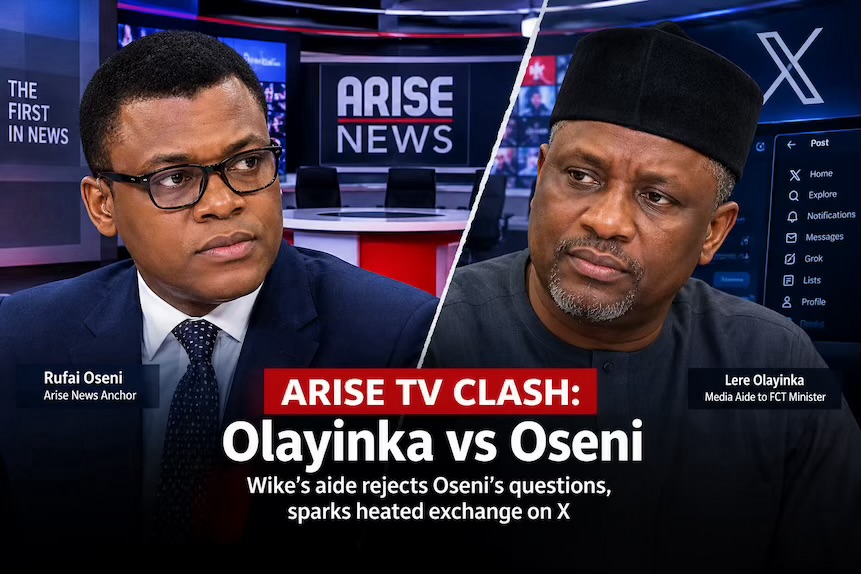

An interview between Arise News presenter Rufai Oseni and Lere Olayinka, media aide to FCT Minister Nyesom Wike, ended abruptly over the weekend after Olayinka refused to take questions from the broadcaster.
Olayinka said he would not answer Oseni’s questions, accusing the presenter of using insulting language against public figures.
“I don’t want to answer any question from you Oseni Rufai. I want this conversation to be among reasonable human beings. People who won’t describe other people as ‘Gbewudani’,” Olayinka said during the interview.
The exchange quickly became a wider dispute between the two men, with both later continuing their arguments on X.
Why the interview broke down
Olayinka was under no obligation to answer questions if he was uncomfortable with the line of questioning. However, his decision to reject the presenter personally rather than engage with the issues raised turned the interview into a confrontation over the conduct of political interviews.
Akin Osuntokun, ARISE News Political Director, criticised Olayinka’s approach while acknowledging his right to decline questions.
“Lere Olayinka was under no compulsion to speak or answer. Whether he was invited or invited himself, he was still at liberty to say what he wanted to say. However, the manner in which he spoke was unfortunate and did little to strengthen his position,” Osuntokun said.
The incident highlights a recurring tension in political broadcasting: public officials and their representatives may challenge the framing of questions, while journalists are expected to press them for answers on matters of public interest.
Also Read: Datti Baba-Ahmed: “I warned Peter Obi against joining ADC” https://olokunsmedianetwork.com/2026/09/07/datti-baba-ahmed-i-warned-peter-obi-against-joining-adc/
The dispute moves to X
The disagreement did not end when the interview stopped.
Oseni later posted on X:
“When they run from your questions you are asking the right questions.
That’s why the run”
Olayinka responded with a lengthy personal attack, bringing Oseni’s family background into the dispute.
“Evidence of ‘Born by Mistake’
When a mother, who had stopped having children for 10 years, after having 3 children for her husband gets impregnated by another man (while still in her husband’s house), there is no how the product of such MISTAKE PREGNANCY won’t become cantankerous and toxic.”
Olayinka also made a separate personal remark about Oseni’s marital status and private life.
“Why won’t a 46-year-old man, who has never been married and probably medically unfit to sleep on the same bed with a woman ‘dey kampe’ all the time?
What exactly is he using his body to do?”
The exchange has since attracted attention beyond the original interview, as supporters and critics of both men continue to debate their conduct online.
Grammar becomes part of the fight
The dispute later took another turn when Olayinka criticised the grammar in one of Oseni’s posts.
Olayinka wrote:
“1st Paragraph - Incomplete statement
2nd Paragraph - What type of statement is ‘Again, we start again!’
3rd Paragraph - Mistakened? It is MISTAKEN
4th Paragraph - I will be speak? No ooo. It is I WILL BE SPEAKING
Alliance France’s? No nah. It is Alliance Française.
Walahi, Pressure Ti Wa Seriously”
Oseni replied:
“With all the noise if you think I will stop doing my work because of you!
Hahahahahah! You are mistakened ooooo
Again, we start again!
Infact I will be speak at Alliance France’s Ikoyi this evening
Pls make plans to be there!”
The response appeared to turn Olayinka’s criticism of his grammar into another point of humour, while also signalling that the dispute would not affect Oseni’s public engagements.
A wider issue for political journalism
The confrontation matters beyond the personalities involved because political interviews often serve as a way for viewers to question people who hold or influence public office.
Olayinka is a media aide to Wike, who serves as Minister of the Federal Capital Territory. His public statements can therefore attract attention because they often form part of the wider political communication around the minister.
For journalists, the incident also raises questions about how far an interviewer should push a political guest and how guests should respond when they believe questions are unfair, offensive or provocative.
There is nothing unusual about political figures challenging journalists. Equally, journalists have a responsibility to ask difficult questions, particularly when the subject concerns public policy, government decisions or the conduct of public officials.
But personal attacks can move the discussion away from those issues.
In this case, the argument shifted from the substance of Oseni’s questions to accusations about his language, family circumstances, age, marital status and grammar.
What happens next?
The online dispute may continue, but the more important question is whether future interviews involving government representatives can return attention to the issues that affect the public.
For viewers, the disagreement offers a reminder that political interviews are most useful when journalists scrutinise public claims and guests respond to substantive questions.
The incident also puts pressure on both sides to distinguish robust political questioning from personal abuse.
For now, the interview has ended, but the argument between Olayinka and Oseni appears far from over.