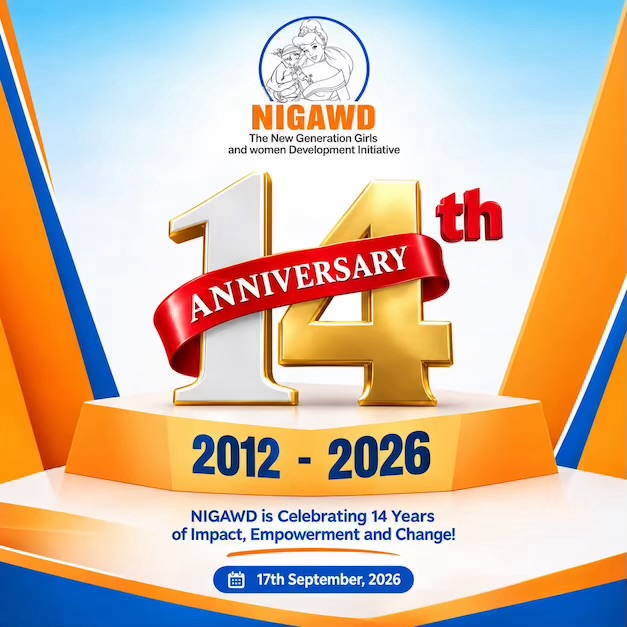

The New Generation Girls and Women Development Initiative (NIGAWD) has marked 14 years of advocacy on women’s rights, gender-based violence, harmful cultural practices, sexual and reproductive health and democratic participation.
The organisation, which was established in 2012, said it would use its 15th year to expand grassroots work while strengthening its involvement in policy, research, youth participation and digital advocacy.
NIGAWD made the announcement on Thursday as it marked the anniversary of its establishment in Ekiti State.
Its work spans several areas, including ending female genital mutilation (FGM), preventing and responding to gender-based violence, supporting women and girls, promoting sexual and reproductive health rights, and encouraging youth participation in elections.
The organisation also runs the Youth Electoral Reform Project (YERP-Naija) and the Vote Not Fight campaign, which focus on youth engagement and peaceful elections in south-west Nigeria. Its website lists electoral reform, women’s political participation and democracy and good governance among its areas of work.
From grassroots advocacy to electoral monitoring
NIGAWD’s anniversary comes shortly after its involvement in monitoring the 2026 Osun State governorship election.
The organisation said it operated a situation room under YERP-Naija to monitor the election and integrate electoral data. Its recent public communications also said the exercise involved support from the National Democratic Institute.
The organisation’s electoral work reflects a broader shift in Nigerian civil society towards real-time election monitoring, voter education and efforts to increase young people’s participation in democratic processes.
NIGAWD says its Vote Not Fight campaign has promoted peaceful elections across the six south-western states.
Tackling FGM remains a major focus
FGM has also remained a significant part of NIGAWD’s advocacy.
The organisation says it has worked with communities to discourage the practice and protect girls from FGM. Its current programme describes an approach involving community engagement, young people, traditional leaders and advocacy for stronger legal protection.
Independent UNFPA documentation also identifies NIGAWD as one of the organisations involved in efforts to address FGM in Nigeria. UNFPA’s 2024 country snapshot lists NIGAWD among partners working on FGM-related interventions.
Nigeria has made progress in reducing FGM, but the practice remains a public-health and human-rights concern. UNFPA data cited from national surveys showed the prevalence among women aged 15 to 49 fell from 19.5% in 2018 to 15.1% in 2021, while the rate among girls aged 0 to 14 fell from 19.2% to 8.2% over the same period. UNFPA said efforts would need to accelerate to meet the 2030 elimination goal.
NIGAWD’s work therefore takes place within a wider national and international effort to change social norms, protect girls and strengthen enforcement against harmful practices.
Rights and policy advocacy
The organisation also says it has campaigned for stronger implementation of laws and regional instruments protecting women’s rights, including the African Union’s Maputo Protocol.
Nigeria ratified the Maputo Protocol in 2004 and deposited its instrument of ratification in 2005. The protocol establishes protections covering areas including women’s health, reproductive rights and protection from harmful practices.
The challenge for organisations such as NIGAWD is not simply whether laws exist, but whether women and girls can access those protections in practice.
NIGAWD has also identified the Ekiti State GBV prohibition law among the legal resources relevant to its work.
Also Read: King’s College concession paused as old boys deny school sale https://olokunsmedianetwork.com/2026/09/17/kings-college-concession-paused-as-old-boys-deny-school-sale/
Support for girls, women and young people
NIGAWD says its programmes have included efforts to return teenage mothers to school, support vulnerable women and children, and provide economic empowerment opportunities for women and girls.
Its current economic empowerment programme focuses on entrepreneurship, budgeting, savings and income-generating opportunities.
The organisation also says its adolescent sexual and reproductive health programmes, When Girls Talk and When Boys Konnet, have reached more than 10,000 young people.
It has additionally promoted digital access to sexual and reproductive health information through its AskNIVI platform.
However, figures supplied by an organisation about the reach or impact of its own programmes should be distinguished from independently evaluated outcomes. NIGAWD’s anniversary statement does not provide a detailed evaluation of the claimed 10,000 beneficiaries or the longer-term results of the programmes.
Survivor-centred approach to GBV
Another part of NIGAWD’s work has focused on how survivors of gender-based violence are represented in public advocacy and the media.
Founder and Executive Director Abimbola Aladejare-Salako has promoted what the organisation describes as ethical storytelling and the “Do No Harm” principle when reporting or communicating survivors’ experiences.
NIGAWD says Aladejare-Salako also served on the Civil Society Africa Reference Group for the Spotlight Initiative and used international platforms to advocate for survivor-centred approaches.
That issue remains important because public campaigns about violence against women can raise awareness while also creating risks of exposing, stigmatising or retraumatising survivors.
Fourteen years of advocacy
NIGAWD says it began on 17 September 2012 from a small shop after Aladejare-Salako received what she described as a vision earlier that year.
The organisation says its first institutional funding came through the European Union’s 10th European Development Fund, implemented through UNDP and UNODC. It also lists organisations including UNFPA, the National Democratic Institute, Equal Measures 2030, AmplifyChange and Equality Now among its past or current partners.
The United Nations civil society database lists NIGAWD as a Nigerian non-governmental organisation working on issues including women’s rights, gender equality, capacity building, violence against women and the girl child.
Reflecting on the organisation’s journey, Aladejare-Salako said:
“Fourteen years ago, as a young woman with no support, I took a leap of faith to obey an instruction. I didn’t know if this vision would collapse at year three. Today, we look back at a 14-year journey of immense impact, powered by the grace of God and the dedication of our vision helpers. We have ensured that the voices of women are protected, their stories are told with dignity, and our democratic institutions are held accountable.”
What happens next?
As it enters its 15th year, NIGAWD says it plans to increase its grassroots presence while contributing more to national, regional and continental policy discussions.
It has identified gender-based violence, women’s rights, harmful social norms, digital inequality, youth participation and democratic accountability as areas requiring continued attention.
The organisation also says it intends to invest in research, leadership development, partnerships and digital tools.
For NIGAWD, the next stage will provide an opportunity to demonstrate how its programmes translate into measurable outcomes for women, girls and young people.
Its anniversary is therefore not only a celebration of longevity. It also raises a broader question for civil society organisations: how can advocacy translate into sustained changes in communities, institutions and public policy?
NIGAWD’s continued electoral monitoring, rights advocacy and grassroots programmes will provide some of the evidence against which that next phase can be assessed.