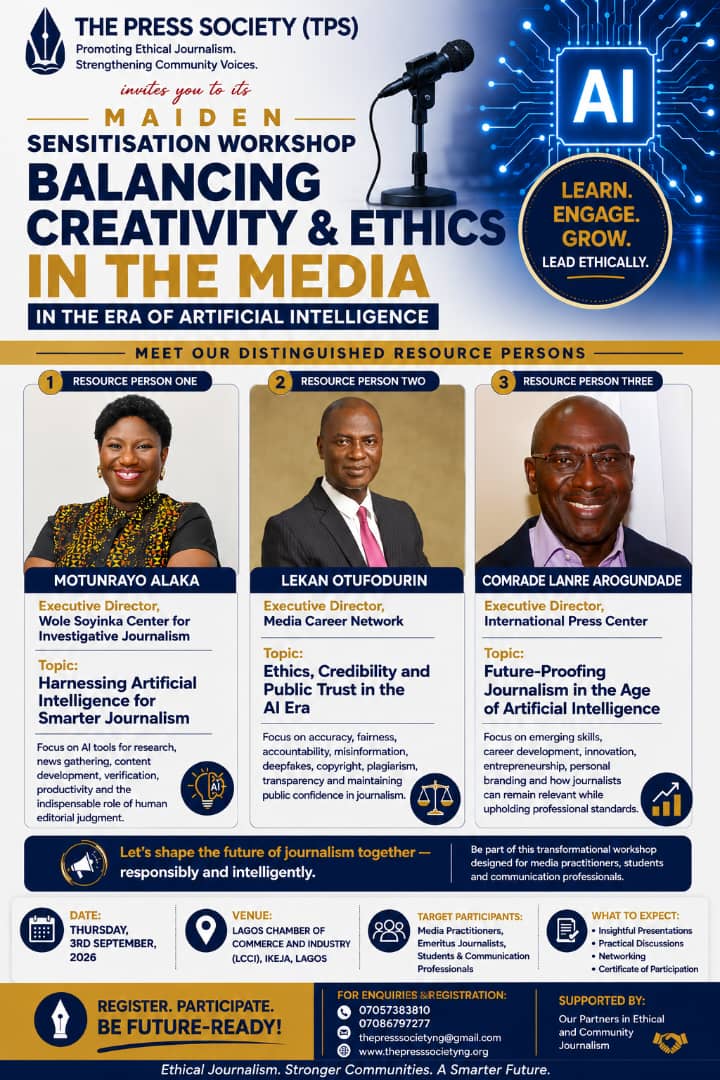

A planned media workshop in Lagos will examine how Nigerian journalists can use artificial intelligence without weakening the accuracy, ethics and public trust on which journalism depends.
The Press Society (TPS) says it will hold its first sensitisation workshop on 3 September at the Lagos Chamber of Commerce and Industry in Ikeja, under the theme, “Balancing Creativity and Ethics in the Media in the Era of Artificial Intelligence.”
The event comes as AI tools are becoming increasingly common in Nigerian news production, but formal newsroom policies and structured training have not kept pace with their adoption.
The 2026 Reuters Institute Digital News Report says AI-generated content and visuals are increasingly appearing in Nigeria's news ecosystem, while a formal framework for their use is still emerging.
It also reports concerns about AI-generated propaganda, including material produced in local languages.
A separate survey presented by the Safer Media Initiative earlier this year found that 95% of journalists surveyed in Nigeria used AI tools at least once a week, while only 10% had received structured AI training from their newsrooms.
The survey was presented at a journalism training programme in Lagos and reported by the News Agency of Nigeria.
That gap raises a more immediate question than whether journalists should use AI: are they being trained to recognise when the technology is wrong?
Three media specialists announced
TPS has named three media professionals as resource persons for the workshop.
Motunrayo Alaka, Executive Director and Chief Executive Officer of the Wole Soyinka Centre for Investigative Journalism (WSCIJ), is expected to lead a session titled “Harnessing Artificial Intelligence for Smarter Journalism.”
Her session is expected to examine the use of AI in research, news gathering, content development, verification and newsroom productivity, while stressing the continuing role of human editorial judgement.
Alaka's current position is independently confirmed by WSCIJ, which describes her as its Executive Director/CEO and says she has worked in journalism, media innovation, investigative reporting and media development.
Her involvement is particularly relevant because the debate over AI is not simply about faster writing.
Investigative journalists, for example, may use AI to process large amounts of information, but the technology does not remove the need to establish the authenticity of documents, verify sources or independently confirm allegations.
Lekan Otufodunrin, Executive Director of the Media Career Development Network, is listed to speak on “Ethics, Credibility and Public Trust in the AI Era.”
His session is expected to address accuracy, fairness, accountability, misinformation, deepfakes, copyright, plagiarism and transparency.
The third resource person, Lanre Arogundade, Executive Director of the International Press Centre (IPC), is expected to discuss “Future-Proofing Journalism in the Age of Artificial Intelligence.”
Arogundade's position at IPC is independently confirmed by the organisation.
He was also elected in July to the 2026–2029 Council of the International Freedom of Expression Exchange, an international network focused on freedom of expression and access to information.
The real problem is not simply access to AIAI can make some newsroom tasks faster.
Research published in 2026 based on interviews with 50 journalists in Nigerian newsrooms found that journalists were using AI mainly for tasks including transcription, copy-editing and preliminary drafting.
The researchers found that journalists generally retained final editorial authority, but that AI was nevertheless changing how newsroom work was distributed and how professional judgement was exercised.
That distinction matters.
An AI system can summarise a 100-page document in seconds, but a journalist still has to determine whether the summary omitted an important qualification or misunderstood a statement.
Likewise, an AI-generated transcription may save time, but an incorrectly transcribed name, figure or quotation can change the meaning of a news report.
The Nigerian Press Council's Code of Ethics already places responsibility for editorial decisions on professional journalists and states that journalists should diligently establish the truth of events.
It also identifies accuracy, fairness and public trust as fundamental objectives of journalism.
AI therefore does not create a completely new ethical framework.
Instead, it creates new ways in which existing journalistic responsibilities can be breached.
Who benefits and who carries the risk?
For journalists and smaller newsrooms, the attraction is obvious.
AI tools can potentially reduce the time required for transcription, translation, document analysis, data processing and routine editing.
For organisations working with limited staff, those efficiencies could free reporters to spend more time reporting from the field.
But efficiency is not the same as better journalism.
If AI-generated material is published without adequate verification, the speed advantage can become a liability.
A fabricated fact, invented quotation or misleading summary can spread to social media before an editor has an opportunity to correct it.
There are also questions about employment.
Research on journalists in Lagos and Kwara found that journalists generally recognised the potential value of AI but also identified possible job losses, threats to human creativity and integrity, and inadequate monitoring as concerns associated with adoption.
For journalists, the issue is therefore not simply whether AI will make their work easier.
It is also whether employers will use the technology to improve journalism or primarily to reduce the cost of producing it.
The timing of the workshop is significant because the technology is advancing faster than many newsroom rules.
The Reuters Institute's 2026 assessment of Nigeria's media environment describes AI experimentation as part of a wider transformation of the country's digital news ecosystem, while noting that formal guidelines are still developing.
That leaves news organisations facing a difficult balance.
Ignoring AI could leave journalists less competitive and less able to use tools that can assist legitimate reporting.
But embracing it without clear editorial safeguards could damage the very asset media organisations depend on: public trust.
For readers, the consequences are straightforward.
If AI is used responsibly, it could help journalists investigate more efficiently and make complex information easier to understand.
If it is used carelessly, it could make false information cheaper, faster and more convincing.
The TPS workshop, scheduled for 3 September, therefore offers an opportunity to move the conversation beyond enthusiasm about new technology.
Its real test will be whether participants leave with practical standards for deciding when AI should be used, when it should not be used, how its output should be verified, and who remains accountable when it gets something wrong.