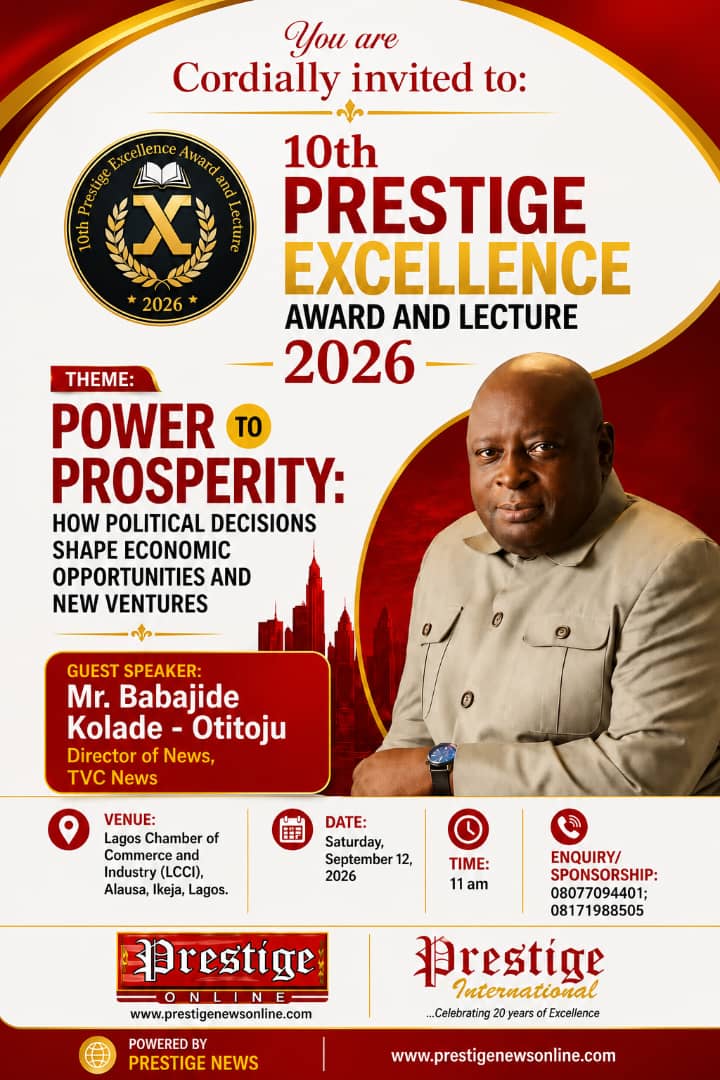

The 10th Prestige Excellence Award and Lecture will focus on how political decisions affect economic opportunities and the creation of new businesses in Nigeria, as the country continues to navigate the effects of major economic reforms.
The annual event, organised by Prestige News, is scheduled for 12 September 2026 at the Lagos Chamber of Commerce and Industry Conference and Exhibition Centre in Alausa, Ikeja.
Its theme is “Power to Prosperity: How Political Decisions Shape Economic Opportunities and New Ventures.”
Investigative journalist and TVC News Director, Babajide Kolade-Otitoju, is billed as the guest speaker.
The choice of theme comes at a time when government policy is having a direct effect on the cost of doing business and household finances.
Nigeria has spent the past three years implementing major reforms, including changes to the foreign exchange market, the removal of the petrol subsidy and efforts to increase government revenue.
The World Bank says those reforms have helped improve macroeconomic stability, but warns that many households have yet to feel the full benefits.
Its April 2026 Nigeria Development Update said poverty remains high and called for the gains from economic stabilisation to translate into better livelihoods.
The International Monetary Fund has similarly said reforms have strengthened Nigeria's economic resilience, while noting that poverty, food insecurity, inflation and infrastructure gaps remain significant challenges.
That makes the question at the centre of this year's lecture broader than an award ceremony.
Political decisions on taxation, foreign exchange, energy, trade, infrastructure and regulation can determine whether businesses expand, reduce operations or leave a market.
The World Bank has identified unreliable electricity, limited access to finance, trade restrictions and weak infrastructure among the constraints affecting private investment and productivity in Nigeria.
Small businesses are particularly exposed to such policy changes.
A World Bank-backed $500m financing programme approved in 2025 was designed to expand access to finance for Nigerian micro, small and medium-sized enterprises, which face longstanding barriers to formal credit.
Against that background, the organisers say the lecture will examine the relationship between political choices and economic prospects.
According to Wale Abiodun, CEO of Prestige Media Group, the Prestige Excellence Award and Lecture was established to recognise individuals, companies and professional institutions considered to have made significant contributions to Nigeria.
“Our news platform is dedicated to extolling the virtues of hard work, ingenuity, integrity and uncommon achievement in service delivery.
The PEAL 2026 edition is tailored to honour and celebrate individuals and organizations who have exemplified those virtues in the course of the year under review”, he said.
Abiodun said the event would also bring together people from different sectors.
He added that the programme is expected to provide opportunities for networking and corporate engagement, while recognising individuals for “excellence, leadership and service to humanity”.
Prestige Excellence Award and Lecture has been held for several years.
The 2024 edition, for example, was the eighth edition and included awards for professionals and organisations across different sectors.
The ninth edition followed in 2025, when the organisers again described PEAL as a platform for recognising professional excellence and leadership.
The 2026 edition therefore marks a decade of the programme.
Kolade-Otitoju's involvement also gives the lecture a strong media and public-affairs dimension.
He became TVC Communications' Director of News in December 2025 and remains a prominent commentator on Nigerian political and economic affairs.
The veteran journalist marked his 60th birthday in March 2026, with President Bola Tinubu praising his journalism and describing him as someone known for speaking truth to power.
The challenge for the lecture will be to move beyond general discussions about leadership and connect political decisions to measurable outcomes for Nigerians.
For businesses, that means questions about taxes, access to credit, electricity, foreign exchange and regulation.
For households, it means examining whether reforms are translating into lower living costs, better jobs and improved public services.
The event is expected to take place on 12 September.
What follows from the discussions, and whether the organisers publish concrete recommendations or commitments, will determine whether the lecture becomes more than another annual gathering.