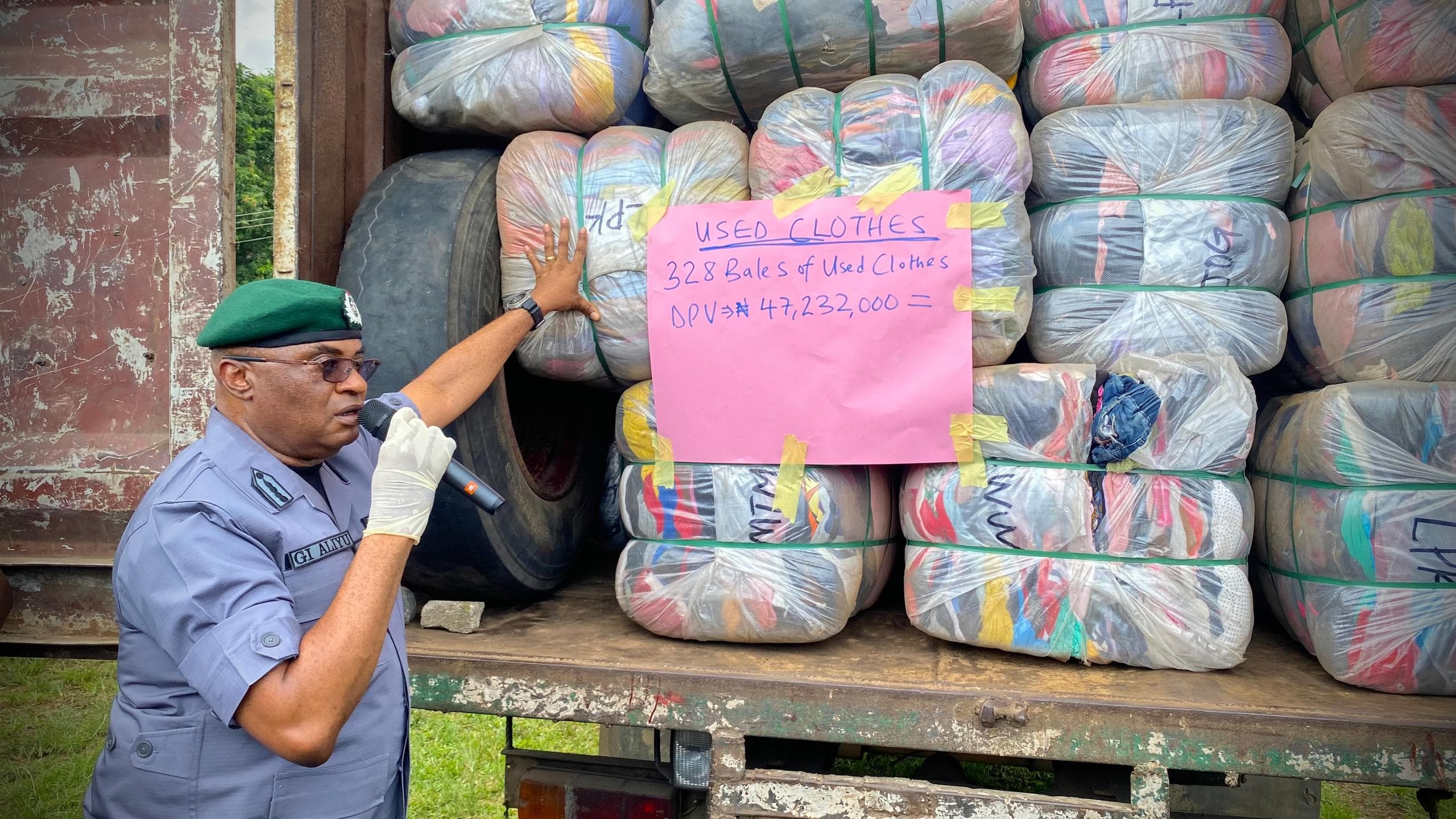

The Nigeria Customs Service says its Federal Operations Unit Zone ‘A’ has intercepted 220 consignments of prohibited and smuggled goods with a stated duty-paid value of N3.24 billion and recovered almost N729 million in revenue.
The unit, based in Ikeja, Lagos, said the seizures included foreign rice, illicit drugs, pharmaceutical products, petroleum products, used vehicles, poultry, clothing, tyres and elephant tusks.
The service said the 220 interceptions were made through what it described as intelligence-led operations, risk profiling and checks on suspicious declarations.
What was seized?
Among the largest seizures were 4,956 bags of foreign parboiled rice, each weighing 50kg, which Customs said was equivalent to eight trailer loads.
Officers also intercepted 2,683 parcels of synthetic cannabis weighing about 1,439.9kg, 49 parcels of Ghanaian Loud weighing 26.1kg, one parcel of crystal methamphetamine and 13 parcels of granular cannabis.
The operation also produced 240,000 tablets of Tramadol and 12,000 tablets of Hypnox.
Other items included 12 foreign-used vehicles, 24,100 litres of Premium Motor Spirit, 686 cartons of foreign poultry products, 26 cartons of foreign vegetable oil, 414 bales of used clothing and 2,947 used tyres.
Customs also reported the seizure of 22 elephant tusks weighing 130.84kg.
The presence of narcotics and pharmaceutical products gives the operation a public-health dimension, while the seizure of ivory raises wildlife-protection concerns.

Revenue recovery
Comptroller gumbo Aliyu, who heads FOU Zone ‘A’, said the N728.98 million recovered was encouraging and pledged to pursue revenue lost through under-declaration, false declarations and other customs violations.
He urged importers, exporters and licensed customs agents to make accurate declarations and comply with customs regulations.
The figure recovered is about 22.5% of the N3.24 billion duty-paid value given for the seized consignments.
A wider crackdown
The latest announcement follows a series of large anti-smuggling operations by FOU Zone ‘A’ under Comptroller Aliyu.
In February, the unit said it had intercepted 144 smuggling attempts involving goods valued at more than N3.3 billion.
The seizures included foreign rice, vehicles, vegetable oil, petroleum products, used clothing and synthetic cannabis.
By May, Customs said the unit had intercepted 473 smuggling attempts in eight weeks, with seized goods given a duty-paid value of about N5.5 billion.
The reported haul included 8,794 bags of foreign rice, 22 used vehicles, 31,705 litres of petrol, 531 cartons of poultry products and 485 used tyres.
Aliyu had also said in April that seizures by the unit had exceeded N6 billion between his assumption of office in December 2025 and the end of the first quarter of 2026.
These figures suggest sustained enforcement activity, although the latest statement does not say whether its N3.24 billion figure represents a new period after those earlier operations or overlaps with them.
Why the seizures matter
Customs enforcement affects more than the traders whose goods are intercepted.
The government relies on import duties and other customs revenue, while local manufacturers and farmers have long argued that smuggled goods can undercut products made or legally imported into Nigeria.
At the same time, restrictions on imports can have consequences for consumers.
Where domestic supply is insufficient or more expensive, tighter enforcement against imported food products can contribute to higher prices unless local production keeps pace.
Nigeria Customs says its mandate is not only enforcement but also trade facilitation and revenue collection.
Its current policy direction emphasises revenue collection, border protection, compliance and the use of technology and data analytics.
The Nigeria Customs Service Act 2023 provides the legal framework for customs administration, including controls on prohibited and restricted imports.
The service also operates an online tariff and Common External Tariff lookup system through which importers can check classifications, duty rates and import prohibitions.
For now, Customs says it will maintain its enforcement campaign while urging legitimate traders to comply with import rules.