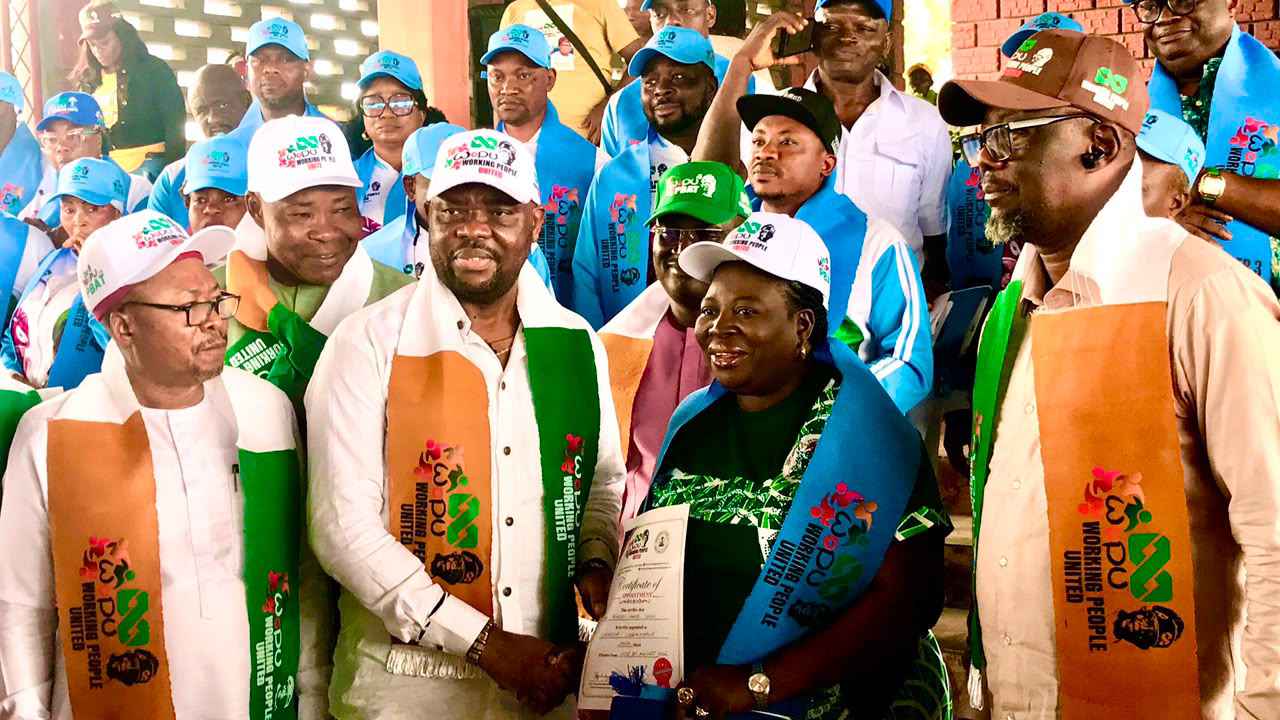

Working People United (WoPU), a pro-President Bola Tinubu workers' movement, has accused some officials of the Nigeria Labour Congress (NLC) of trying to stop its Lagos chapter inauguration.
WoPU says the officials circulated a directive asking presidents and general secretaries of NLC-affiliated unions to boycott the event held on Wednesday, 12 August.
The movement described the alleged directive as “dictatorial” and said it infringed on workers' freedom of association.
However, WoPU did not provide an independently verifiable copy of the alleged circular in the statement supplied for publication.
The claim should therefore be treated as an allegation unless the NLC confirms that such a directive was issued.
The NLC had not publicly responded to the allegation in the material reviewed for this report.
What is WoPU?
WoPU is a political and civic movement that brings together labour figures, professionals, artisans, traders and other workers.
It emerged publicly in Abuja in March and has since backed Tinubu's re-election bid in 2027.
Reports of its activities show that it has sought support among workers beyond the traditional trade union structure.
In July, the group inaugurated its Delta chapter and endorsed Tinubu and Delta State Governor Sheriff Oborevwori for the 2027 elections.
The Delta inauguration was held at the NLC secretariat in Asaba, despite WoPU's claim that it does not seek to replace or undermine organised labour.
WoPU's own website describes it as a civic movement for workers, professionals and communities across Nigeria.
It says it aims to promote good governance, economic stability and worker participation in politics.
Why has the dispute emerged?
The dispute appears to centre on the intersection between organised labour and electoral politics.
WoPU openly supports Tinubu's return to office in 2027.
It says workers should be free to make political choices independently rather than follow the preference of labour leaders.
In its statement, the movement accused the NLC leadership of trying to compel workers to support the Labour Party.
“It is unfortunate that some persons in NLC are now arrogating powers they do not possess by directing individual, Unions, affiliates that their members should only join and support Labour Party,” WoPU said.
It also alleged that the same approach was used during the 2023 presidential election.
There is evidence that the NLC publicly mobilised workers behind the Labour Party and its presidential candidate, Peter Obi, during that election.
In February 2023, the NLC directed its political committees to mobilise workers and voters for Mr Obi and other Labour Party candidates.
The NLC and Trade Union Congress had also publicly backed Obi in 2022, with then-NLC president Ayuba Wabba saying organised labour would mobilise for his victory.
That history gives context to WoPU's argument, although it does not by itself establish that the NLC issued the alleged 2026 boycott directive.
What does the Constitution say?
WoPU relies heavily on Section 40 of Nigeria's 1999 Constitution.
The section protects the right to peaceful assembly and association, including membership of political parties, trade unions and other associations.
The movement argues that workers who belong to NLC-affiliated unions retain an individual right to participate in political organisations outside the labour movement.
It said the alleged boycott instruction was therefore an “affront on the sensibility of Nigerian workers, Nigerian working people, Nigerian citizens and our constitution and rights.”
WoPU also cited International Labour Organization Convention No. 87 on freedom of association and Convention No. 98 on the right to organise and collective bargaining.
Nigeria ratified both conventions on 17 October 1960 and the ILO lists both as being in force.
But the legal argument is not as straightforward as WoPU's statement suggests.
Freedom of association does not mean that every organisation is prohibited from setting its own rules or positions.
Trade unions also operate under specific Nigerian laws and their own constitutions.
The question in this dispute is therefore narrower: whether an instruction from the NLC to its affiliated unions, if one was issued, would amount to an unlawful restriction on individual workers' rights.
That would depend on the precise wording, authority and purpose of any such directive, as well as the circumstances in which it was issued.
WoPU's political positionWoPU reaffirmed its support for Tinubu's 2027 re-election campaign.
It said its political position represented a choice by its members and was not an attempt to take over the NLC.
The movement said it is “a convergent of like minds across all professions, artisans, Market Men & women, working people from formal sectors & informal sectors, private and public sectors”.
It also rejected claims that it was a parallel labour organisation.“WoPU does not seek to replace or undermine the NLC or any other labour organization,” it said.
Its national coordinator-general, Prince Williams Akporeha, has previously described the movement as a political and civic platform designed to increase workers' participation in governance.
The group has also openly promoted Tinubu's economic reforms.
At a WoPU-organised Good Governance Summit in June, Chief of Staff Femi Gbajabiamila said the N70,000 national minimum wage would need to be reassessed against changing economic conditions.
That places WoPU on a different political footing from sections of organised labour that have opposed some of the administration's economic policies.
Why the dispute matters
The disagreement is significant because organised labour remains an important political and industrial force in Nigeria.
The NLC represents affiliated trade unions, while WoPU is positioning itself as a broader political movement that includes workers outside the formal union structure.
The distinction matters.
A worker can belong to a trade union while also supporting a political movement.
Membership of a union does not automatically determine how an individual votes in an election.
At the same time, an organisation such as the NLC can make collective political decisions through its established structures.
The difficult question is whether such collective decisions can be presented as binding political instructions to individual members.
That distinction could become increasingly important as political mobilisation ahead of the 2027 elections intensifies.
What happens next?
WoPU has called on the NLC to withdraw what it described as the boycott directive and respect workers' rights.
It also warned against what it called intimidation or coercion.
“No organisation, no matter how powerful, has the right to tell Nigerian workers which associations they can join,” the movement said.
WoPU further expressed support for its Lagos chairperson, Funmi Sessi, and said any attempt to intimidate or malign her because of her association with the movement would be resisted through lawful means.
“WoPU remains committed to the unity, productivity and progress of Nigerian working people. We shall not be silenced by intimidation,” it said.
The immediate issue is whether the alleged NLC circular exists and, if so, who authorised it and what it actually instructed affiliated unions to do.
A response from the NLC, together with the full circular, would be important in establishing whether WoPU's allegation reflects an official labour position or the action of individual officials.