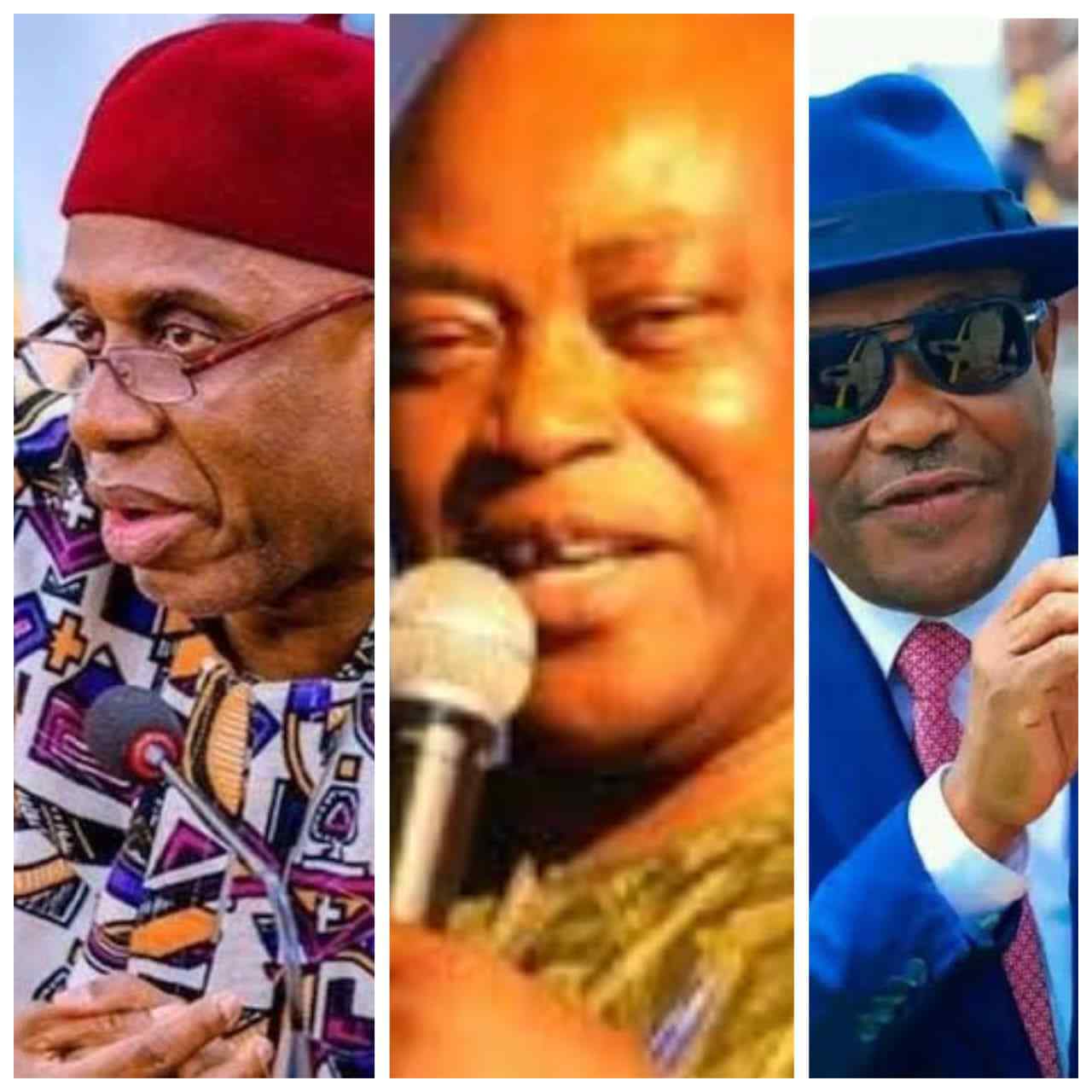

A senior member of the African Democratic Congress (ADC), Chief Eze Chukwuemeka Eze, has defended Rotimi Amaechi’s value to Atiku Abubakar’s 2027 presidential campaign after FCT Minister Nyesom Wike questioned whether the former Rivers governor can deliver electoral gains for the opposition party.
Chief Eze, a former publicity secretary of the defunct New Peoples Democratic Party, made the comments in a statement on Monday while responding to recent criticism by Mr Wike of Mr Amaechi’s selection as Atiku’s running mate.
The dispute is the latest chapter in a long-running political rivalry between the two Rivers politicians, whose relationship dates back to Mr Amaechi’s time as governor.
The ADC formally announced Mr Amaechi as Atiku’s running mate in June, after he finished second to Atiku in the party’s presidential primary.
The party later submitted the pair’s particulars to the Independent National Electoral Commission (INEC) for the 2027 election.
What Wike said
Nyesom Wike has repeatedly questioned what Amaechi would add to Atiku’s presidential campaign.
During a media chat in Port Harcourt, the FCT minister argued that Amaechi lacked the political capital to deliver Rivers State and the wider South-South region for the ADC ticket.
He also questioned Amaechi’s electoral record, pointing to the 2019 presidential election and arguing that he could not secure the required 25% of votes in Rivers for then-President Muhammadu Buhari.
The comments were reported by several Nigerian media organisations.
Wike had also criticised Amaechi’s decision to contest the ADC presidential primary earlier in the year, saying he would have advised his former political associate against running on the party's platform.
That criticism is significant because Wike previously served as Amaechi’s Chief of Staff when Amaechi was Rivers governor.
Their political relationship later deteriorated into one of Nigeria’s most closely watched intra-state rivalries.
Eze's response
Chief Eze rejected Wike’s assessment and accused him of attacking Amaechi because of the latter’s political importance to the ADC ticket.
He said: “Wike knows that the Abubakar-Amaechi joint ticket portends great danger for the APC presidential candidate, Bola Tinubu and his bunch of clueless kitchen cabinet who have failed Nigerians.”
He added: “If Amaechi will not add electoral and triumphant value to the ADC's quest to unseat Tinubu, why then is Wike shivering and casting aspersion on the person of his former boss, Amaechi?”
Chief Eze also described Wike as an “ungrateful man”, “nuisance”, “serial blackmailer” and “backstabber”, among other personal attacks.
He said: “You personify ingratitude. You see yourself as Mr know it all that's your greatest undoing. When a man cares less about God's grace and decides to see himself as a demi-god, one day he will meet his waterloo.”
Chief Eze further accused Wike of being responsible for wrongdoing involving public funds in Rivers State.
He said: “In saner climes, Wike is supposed to be languishing in jail for the brazen rape of Rivers State public treasury. All thanks to Governor Similaye Fubara, who condoned Wike's excesses.”
A rivalry with a long history
The exchange cannot easily be separated from the political history between the two men.
Rotimi Amaechi served as Rivers governor from 2007 to 2015 before becoming minister of transportation under former President Muhammadu Buhari.
Nyesom Wike succeeded him as governor in 2015 and served two terms before leaving office in May 2023.
He was appointed FCT minister by President Bola Tinubu in August that year.
The relationship between them deteriorated after Wike became governor.
In 2015, Wike’s administration established a judicial commission of inquiry into the previous administration, a move Amaechi and his supporters described at the time as politically motivated.
Their rivalry has continued to shape Rivers politics and has now entered the 2027 presidential contest.
What does Amaechi actually bring to Atiku?
The ADC's case for Amaechi is based largely on his experience and political network.
The party said his selection followed consultations with party leaders, coalition partners, youth and women stakeholders and representatives from the six geopolitical zones.
It also pointed to his second-place finish in the ADC presidential primary.
The primary results also provide an important piece of context.
Atiku received 1,846,370 votes, while Amaechi received 504,117, according to the reported results of the contest.
But experience does not automatically translate into votes.
Wike's argument raises a question the ADC will eventually have to answer with evidence: can Mr Amaechi convert his political experience and personal support base into votes for Atiku across Rivers State and the wider South-South?
The answer will depend on factors such as the strength of the ADC's organisation, voter turnout, alliances with local political actors and whether opposition supporters remain united behind the ticket.
The 2027 calculation
The ADC is trying to challenge a president who won the 2023 election on the platform of the governing All Progressives Congress.
President Tinubu was declared winner of that election, with Atiku finishing second.
The Supreme Court later upheld Tinubu's victory after legal challenges by opposition candidates.
The opposition's challenge in 2027 will therefore involve more than selecting prominent politicians.
It will have to demonstrate that the coalition can build a nationwide organisation capable of converting political alliances into votes.
For voters, the more important question is not whether Amaechi has enemies or political admirers.
It is whether the Atiku-Amaechi ticket can present credible policies, build a broad coalition and persuade Nigerians that it offers a better alternative to the current government.
Chief Eze, however, maintains that Amaechi has the qualities required for the job.
He said: “Amaechi is an epitome of integrity and honesty. He is a man of his word, very loyal, transparent, and accountable for decisions and actions he takes. Above all, he is a team player.”
He also described Amaechi as a defender of constitutional government and human rights, saying he has “the required exposure and experience to serve as Nigeria's Vice President.”
What happens next?
The ADC and its candidates now face the harder stage of the 2027 contest: building a national campaign and convincing voters beyond the political circles surrounding the opposition coalition.
Chief Eze has urged Nigerians to support the effort to defeat President Tinubu, whom he described as “Nigeria's worst President.”
Whether that argument resonates with voters will ultimately be tested at the ballot box.
For now, the latest exchange shows that the old Wike-Amaechi rivalry remains politically relevant and that Amaechi's role on Atiku's ticket is likely to remain a subject of debate as the 2027 election approaches.