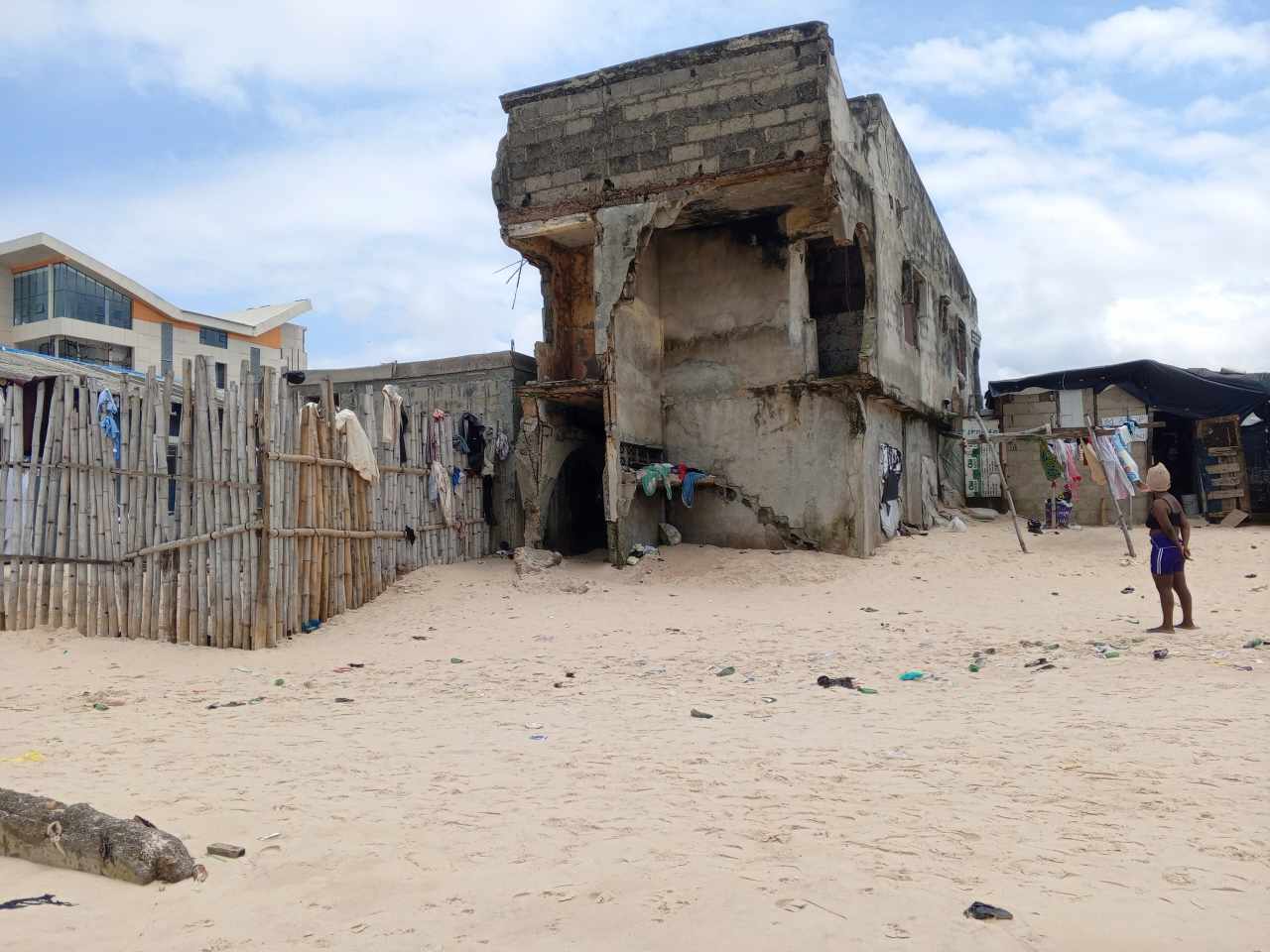

Residents of Okun Alfa, also known as Alpha Beach community, in Lagos State say they are running out of land as coastal erosion continues to eat into homes, businesses and public facilities.
For people such as fish seller Mrs Okonlawon Kazim, the crisis is no longer about losing property.
She says the advancing sea has taken away the homes and farmland that once supported her family and has left her without a permanent place to live.
“My father's house, the sea has carried it away. My mother's house is at Owode down there, it has been destroyed,” Mrs Kazim said.
“I speaking to you presently, I sleep outside.”
Her account reflects a wider problem documented along the Lagos coastline, where erosion, flooding and rising sea levels are putting pressure on communities, infrastructure and livelihoods.
A 2024 Environmental and Social Impact Assessment for the Lagos-Calabar Coastal Highway found that the shoreline between Alpha Beach and Iwerekun had experienced substantial erosion.
Its long-term assessment for 1974-2024 recorded erosion across 93.4% of the transects examined in one sector, with the report describing Alpha Beach as “currently seriously eroding”.
A community running out of room
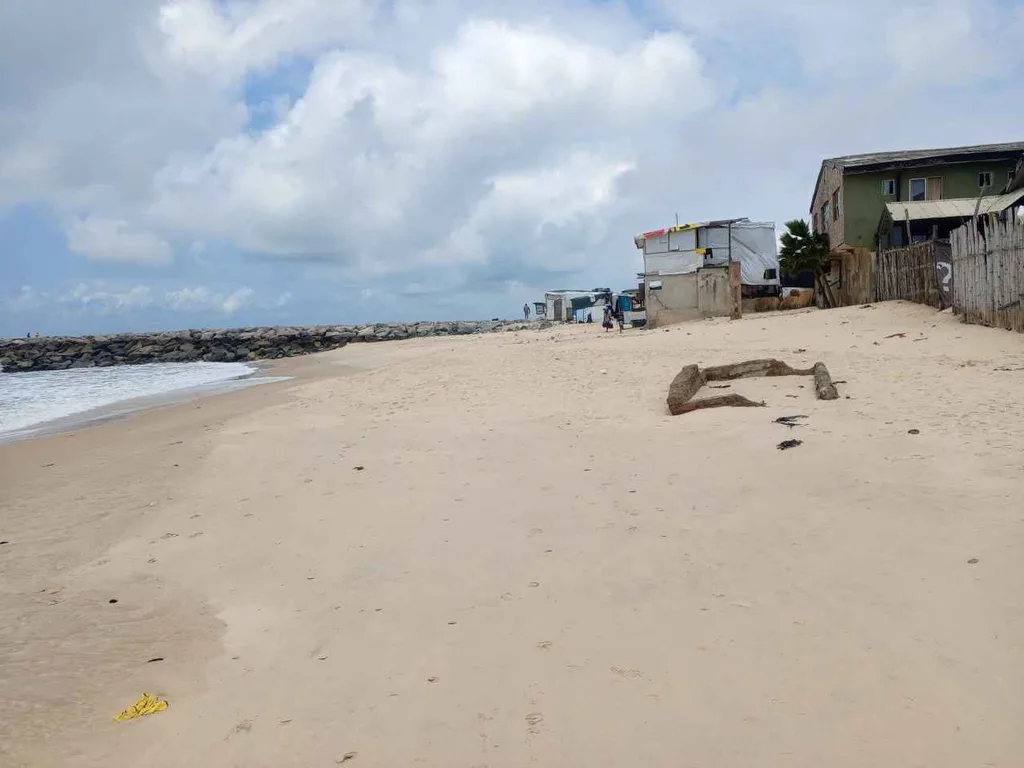
The Okun Alfa/Alpha Beach community has historically responded to the advancing sea by moving further inland.
But community leader, Hon. Prince Sheriff Adekunle Elegunshi, chairman of the Okun Alfa/Alpha Community Development Association, says that option is becoming impossible.
He said earlier settlements were progressively lost to the ocean, forcing residents to establish new ones further inland.

“The first community are submerged. Second community is another thing submerged. Third community are also submerged. Why is the fourth and the last?” he said.
According to Hon. Elegunshi, the community now sits between the Atlantic Ocean and the Lagos-Calabar Coastal Highway, leaving residents with little room to move.
“The only solution is for the government to come and continue the road breakers and also do reclamation the way they did for Eko Atlantic City,” he said.
The community leader's description of the erosion is consistent with earlier research.
A study of Alpha Beach published by the National Open University of Nigeria found that coastal erosion had damaged infrastructure and property, disrupted businesses and contributed to the relocation of residents.
It also found that traditional coping measures such as sandbags, sand mounds and sand fencing were inadequate.
Homes disappear, livelihoods follow
The impact extends beyond buildings.
Mrs Kazim said she had sold fish since 1993 but stopped the business about three years ago because the community lost the landing areas where fishermen previously brought their boats.
“Fish-selling has stopped. I don't sell fish anymore,” she said.
She recalled a time when fishermen arrived with fresh catches and traders could buy directly from them.
But without a reliable landing site, she said, fishermen now struggle to bring their boats close enough for traders to buy their catch.
The disappearance of farmland has also affected household food production.
Mrs Kazim said residents once cultivated cassava, mango and coconut, with families processing cassava into garri and harvesting fruit from nearby farms.
“Now there's nothing anymore. There's no farm, no gari, no anything,” she said.
“There isn't even land left for us to plant anything on — the sea has consumed all of it.”
Also Read: Atiku Pledges to Restore Targeted Fuel Subsidy if Elected in 2027
Women bear a heavy economic cost
For women in the community, the erosion has also meant the loss of trading spaces.
Morayo Liadi said she once sold fish and frozen food but lost the space and equipment needed to continue.
“I even sold my fridge because there was nowhere to keep and sell fish,” she said.
She now cooks food for sale and buys fish in small quantities when boats arrive.
“If I buy iced fish, I carry it on my head and move around because we have no place to keep and sell fish,” she said.
Mrs Liadi said she has lived in a wooden structure for about nine years after water destroyed her house.
Her experience illustrates why coastal erosion is not only an environmental issue.
It is also an economic and social crisis, particularly for households whose incomes depend on fishing, farming, food processing and small-scale trading.
Public services have also been lost
Residents say the erosion has destroyed or displaced public infrastructure.
Mrs Liadi said the community no longer has a functioning health centre and that residents often travel to Igbo Efon for medical treatment.
She said pregnant women sometimes have to travel outside the community to give birth, while some residents rely on traditional birth attendants because of the distance and cost of formal healthcare.
“If there were a hospital in this town, delivery costs would be lower,” she said.Residents are also asking for a functioning school within the community.
Mrs Liadi said many families cannot afford private education and depend on government schools that are far from their homes.
But the absence of basic services in a community facing repeated displacement raises a wider question: how should governments protect essential services when the land itself is becoming increasingly vulnerable?
Residents say earlier intervention helped
Hon. Elegunshi said the community had previously sought government assistance during severe erosion.
He credited the administration of former Lagos State governor, Babatunde Fashola with installing wave breakers that reduced the force of incoming waves.
“The wave breakers that we are seeing at the seaside... reduce the wave power,” he said.
Contemporary reporting also recorded the use of wave breakers around Alpha Beach during the Fashola administration.
A 2017 report said residents believed the intervention had reduced the impact of ocean surges, although they continued to lose sand from the shoreline.
The evidence suggests that coastal defence can reduce immediate exposure, but it does not necessarily resolve the underlying problem.
A 2025 statement from the Lagos State Government said the state was expanding the use of groynes — rigid structures designed to interrupt water movement and help stabilise shorelines — along its 180km coastline.
The government acknowledged that the scale of erosion created a significant financial challenge.
The coastal highway adds another layer
The Lagos-Calabar Coastal Highway has become an important part of the conversation because of its proximity to vulnerable coastal communities.
The project's environmental assessment specifically examined shoreline change and sea-level rise.
The assessment noted that coastal erosion around the project area had been aggravated by storm surges and that changes associated with major coastal developments could affect sediment movement.
Residents in Alpha Beach have raised concerns about the relationship between the road, drainage and their ability to relocate.
However, claims that the highway itself caused the flooding or erosion should not be treated as established fact.
In July 2026, Works Minister David Umahi rejected claims that the Lagos-Calabar Coastal Highway was responsible for flooding in parts of Lagos.
He said the project was designed to improve drainage and help evacuate floodwater from shoreline communities, while acknowledging the need for dredging and other environmental mitigation measures.
That creates an important accountability question for communities such as Alpha Beach: will the highway's drainage and environmental protection measures actually reduce their exposure to flooding, and how will that performance be independently measured?

Government already recognises the wider coastal threat
The Federal Ministry of Environment has a dedicated Erosion, Flood and Coastal Zone Management Department responsible for developing and implementing policies to prevent and control coastal and riverbank erosion.
Lagos State has also acknowledged the seriousness of its coastal challenge.
At a 2025 waterfront summit, the state government said more than 80% of Lagos' shoreline had been lost over time, while pollution, reclamation and climate change continued to threaten the lagoon.
The state subsequently announced plans for further coastal protection partnerships and feasibility studies.
The issue, therefore, is no longer whether Lagos faces a coastal threat.
The question is whether interventions can reach vulnerable communities quickly enough and whether they will protect both infrastructure and livelihoods.
A plea beyond compensation
For Mrs Kazim, the crisis is deeply personal.
She said she has no alternative family home outside the community and fears that future generations could inherit the same problem.
“My father was a native of this town,” she said. “The house that was my father's house, the sea has carried it away.”
Fatimo Gbadebo, known locally as Iya Oosa of Okun Afa/Alpha Beach, said residents remained grateful that the erosion had not, in her experience, resulted in the loss of lives in the community.
But she said the destruction of homes was already severe.
“The sea has destroyed many houses, but it has not taken lives from us,” she said.
She appealed to the government to intervene before the remaining homes and community infrastructure disappear.
For the residents, the demands are straightforward: stronger coastal protection, effective drainage, healthcare, education and support for people who have lost their homes and livelihoods.
But any long-term response will need to go beyond building another barrier.
The evidence shows that Alpha Beach sits within a coastline experiencing persistent erosion.
Protecting the community will therefore require coordinated planning between coastal defence, drainage, road construction, land-use management and livelihood support.
The immediate test is whether the authorities can prevent the fourth settlement from becoming the next one residents are forced to abandon.