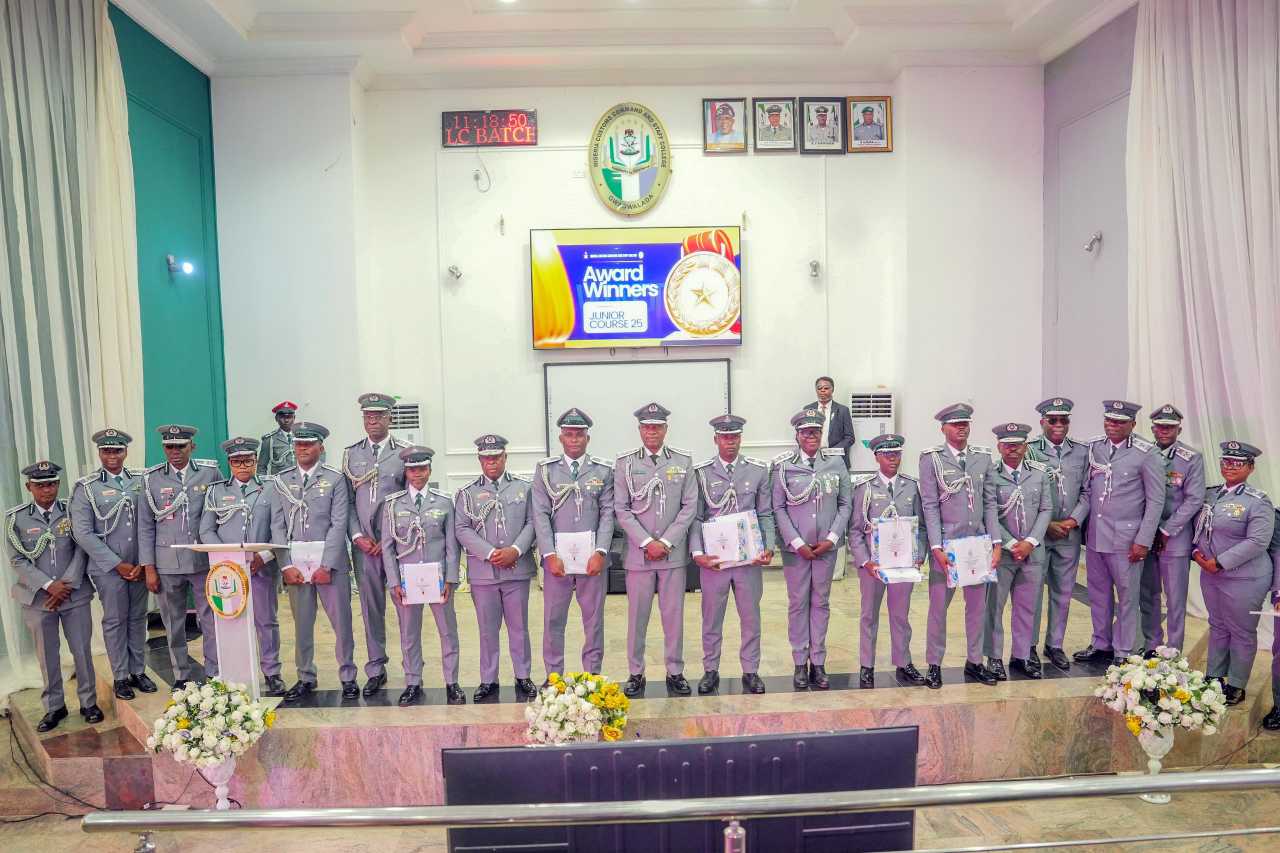

Fifty officers of the Nigeria Customs Service (NCS) have completed a three-month leadership course at the Nigeria Customs Command and Staff College (NCCSC), Gwagwalada, Abuja.
The officers graduated from Junior Course 25 on Friday, 28 August, and are expected to return to Customs commands with responsibility for applying the skills gained during the programme.
At the graduation ceremony, Comptroller-General of Customs Adewale Adeniyi told the officers that rank alone would not make them effective leaders.
“Leadership is not defined solely by the rank that you wear, but is demonstrated through competence, fairness, courage and the responsibility you take,” Adeniyi said.
He urged the graduates to put integrity, sound judgement and national interest ahead of personal gain.
Why the training matters
The Customs Service has a wide-ranging role that affects traders, manufacturers, importers, exporters and consumers.
Its responsibilities include customs control, revenue collection, enforcement and trade facilitation.
Decisions made by officers at ports, borders and other commands can therefore affect the movement and cost of goods.
That makes the quality of operational leadership an issue beyond the Customs Service itself.
The latest course also forms part of a continuing training programme at the Gwagwalada college rather than a new initiative.
In February, the college began Junior Course 24 with 50 officers alongside 50 participants in Senior Course 14.
The Junior Course also lasted three months.
Those participants graduated in April after completing the programme, with Customs urging them to apply their training to their operational duties.
Also Read: Ogun Police Kill Two Suspected Kidnappers, Rescue Truck Driver
From classroom to field
The value of Junior Course 25 will now depend largely on what the officers do after graduation.
Previous Junior Course participants have undertaken operational study tours to Customs commands, where they examined border control, revenue collection and anti-smuggling operations in real working environments.
The study tours have also involved agencies including the Nigeria Immigration Service, National Drug Law Enforcement Agency, Economic and Financial Crimes Commission and National Agency for Food and Drug Administration and Control.
Such inter-agency exposure matters because Customs operations often overlap with wider border-security and regulatory responsibilities.
Customs links training to wider reforms
The Service has increasingly presented professional training as part of its broader attempt to modernise its operations.
At the start of Junior Course 24, Customs said command courses would increasingly become a requirement for career advancement and described the college as a platform for developing officers for more complex security and economic responsibilities.
The Service has also stressed strategic thinking and leadership in training for more senior officers.
In February, Adeniyi said leadership, discipline and strategic thinking were essential to modern Customs administration as senior officers prepared to manage personnel, resources and emerging trade and security challenges.
Customs has also been investing in digital systems.
Its current public-facing platform includes B'Odogwu, which the Service says is designed to simplify trade processing and improve access to customs services.
But technology and training do not automatically produce better outcomes.
The effectiveness of the latest graduates will ultimately be measured by whether they make decisions more consistently, follow due process, improve enforcement and treat legitimate businesses fairly.

College highlights new training methods
The Commandant of the NCCSC, Assistant Comptroller-General Dow Gaura, commended the graduating officers and highlighted improvements at the institution.
These include digital learning tools and training partnerships with the Nigerian Army, according to the Customs Service.
The college has previously described its curriculum as combining leadership, communication and management studies with operational subjects such as classification, valuation and authorised economic operator procedures.
Three officers receive awards
All 50 participants received certificates at Friday's ceremony.
The Comptroller-General also presented special awards to the three highest-performing officers.
Earlier in the week, the college held a regimental dinner on Wednesday, 26 August.
Deputy Comptroller-General Suleiman Chiroma, who represented Adeniyi, urged the officers to take vigilance and decisive leadership into their new assignments.
What happens next?
The graduates will now return to Customs commands and departments to resume their duties.
For the public and businesses, the important test will not be the number of certificates issued but whether the training produces measurable improvements in Customs operations.
That includes faster and more transparent legitimate trade, effective action against smuggling and stronger accountability when officers exercise their powers.
The Service has not announced a separate policy change arising from Junior Course 25.
Its next challenge is to demonstrate that the investment in training produces results that can be seen at Nigeria's borders, ports and other Customs formations.