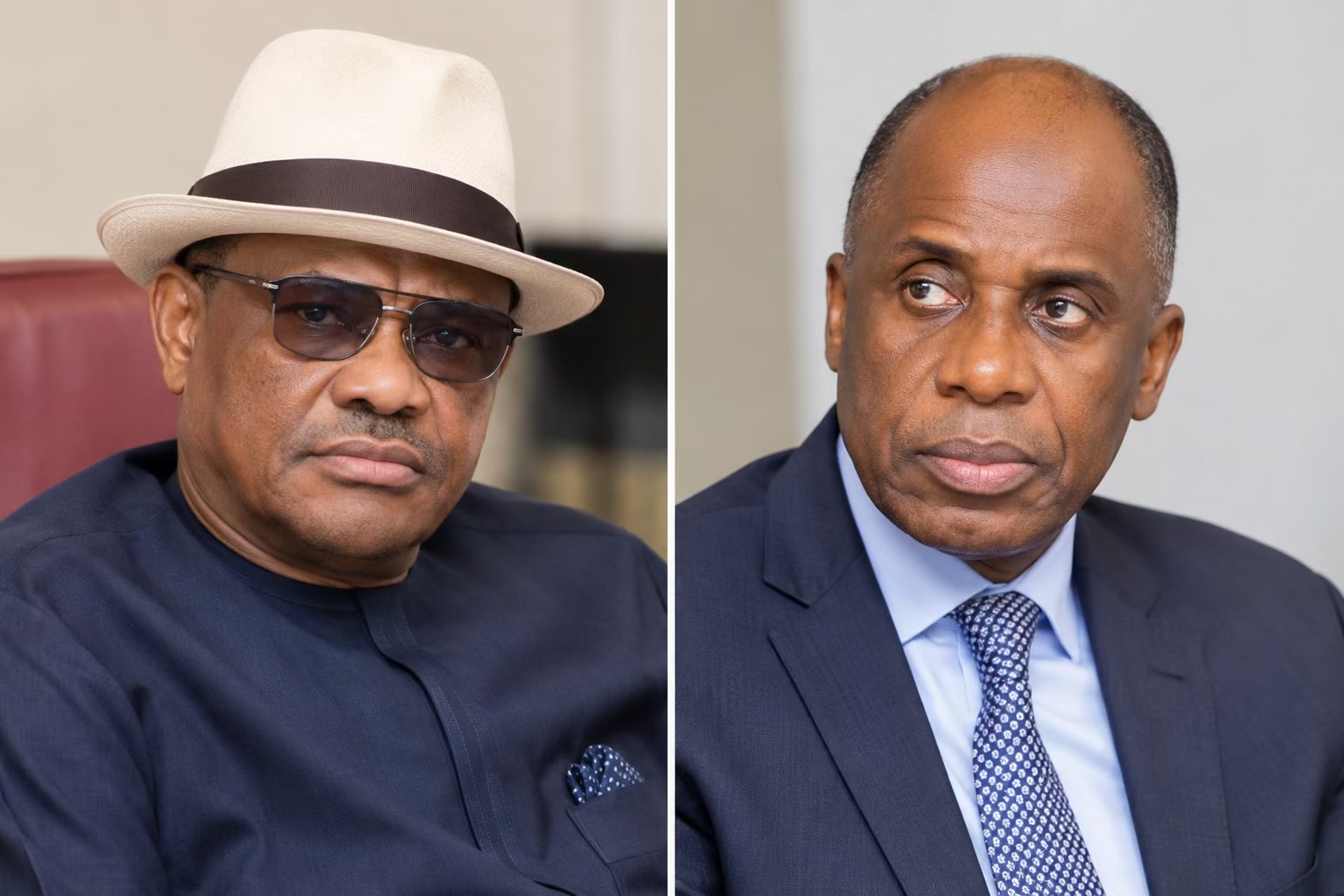

Minister of the Federal Capital Territory, Nyesom Wike, has sharply criticised former Rivers State governor Rotimi Amaechi over his claim that President Bola Tinubu’s economic policies contributed to the death of his mother.
Wike accused Amaechi of using his mother’s death in a political argument and questioned his claim that rising medicine costs made it difficult for him to afford her treatment.
He spoke on Saturday during a visit to the Uzugbani Ekpeye National Executive Council at Ekpeye House in Ahoada East Local Government Area of Rivers State.
The comments followed an interview Amaechi gave to Channels Television’s Politics Today on Friday.
Amaechi, the African Democratic Congress (ADC) vice-presidential candidate for the 2027 election, said the economic consequences of the Tinubu administration’s policies had made it harder for him to obtain the drugs his mother needed.
“Tinubu’s policies killed my mother. Before Tinubu came, my mother was healthy. After 2023, it was difficult for me to buy drugs for my mother,” Amaechi said.
Amaechi’s statement was part of a wider criticism of the government’s economic reforms, including the removal of the petrol subsidy.
He argued that rising living costs and the price of medicines were putting pressure on families and said many Nigerians faced similar difficulties accessing healthcare.

Wike challenges Amaechi’s account
Wike questioned how Amaechi, who held several senior public offices, could say he was unable to buy medication for his mother.
Amaechi served as Speaker of the Rivers State House of Assembly from 1999 to 2007, governor of the state from 2007 to 2015 and Minister of Transportation from 2015 to 2023.
Wike said Amaechi should have sought help from friends and associates if he could not afford the medication.
He also referred to Amaechi’s properties in Port Harcourt and Abuja as part of his argument.
“Look at the house you are living in Old GRA, look at the house you are living in Abuja, and then you said you were unable to buy drugs and that’s why your mother died.
“Enough of this kind of embarrassment. Instead of me having this kind of child, may I be childless.”
Wike also criticised Amaechi for referring to his late mother in connection with the 2027 election.
According to Wike, Amaechi had said in another video that his mother would be happy if the ADC won the election.
Wike argued that bringing a recently deceased relative into an election campaign was inappropriate and accused Amaechi of seeking political sympathy.
What is established about Amaechi’s mother?
Amaechi’s mother, Mary Amaechi, died on 16 July 2026 at the age of 89.
Her family announced her death and described her as a Christian and community leader. She was later buried in Rivers State on 5 September.
There is, however, an important distinction between Amaechi’s account and an independently established medical cause of death.
Amaechi has said the rising cost of medicines under Tinubu made it difficult for him to provide the drugs his mother needed. That is his personal account. It does not, by itself, establish that government policy caused her death.
Also Read: Tiwa Savage responds to Teni’s ₦1.5bn boxing challenge https://olokunsmedianetwork.com/2026/10/04/tiwa-savage-responds-to-tenis-%e2%82%a61-5bn-boxing-challenge/
The wider argument over medicine costs
The dispute comes against the backdrop of Nigeria’s broader cost-of-living crisis and continuing debate over the impact of the Tinubu administration’s economic reforms.
The government has defended the reforms, including the removal of the petrol subsidy, as necessary measures to address structural weaknesses in the economy. Critics, including Amaechi, argue that the reforms have increased pressure on households.
For ordinary Nigerians, the political dispute has a more practical dimension: whether the cost of medicines and other essential goods has become harder for households to absorb.
Amaechi also linked the problem to Nigeria’s dependence on imported pharmaceutical products. He cited figures he attributed to the National Bureau of Statistics while arguing that the country needed to strengthen domestic pharmaceutical production.
Those claims require separate verification and should not be treated as evidence that the government’s policies caused his mother’s death.
Why the exchange matters
The confrontation comes as political parties and politicians position themselves ahead of the 2027 general election.
Amaechi is now the ADC vice-presidential candidate, while Wike remains a senior figure in the Tinubu administration as FCT minister.
Their latest exchange therefore goes beyond a personal disagreement. It places healthcare affordability, the cost of living and the political consequences of the government’s economic reforms back at the centre of the election debate.
For Nigerians facing higher household expenses, the more important question is whether political arguments about medicine prices will lead to measurable policies that improve access to affordable healthcare.
For now, the two politicians remain sharply divided: Amaechi says the government’s economic policies made his mother’s treatment unaffordable, while Wike rejects that argument and has challenged Amaechi to account for why he could not afford the medication.
The next stage of the dispute is likely to centre on the broader 2027 campaign, where the cost of living and access to essential services are expected to remain major issues.