
….Proposed charge could make post-study work in the US more expensive and less accessible for Nigerian and other international graduates.
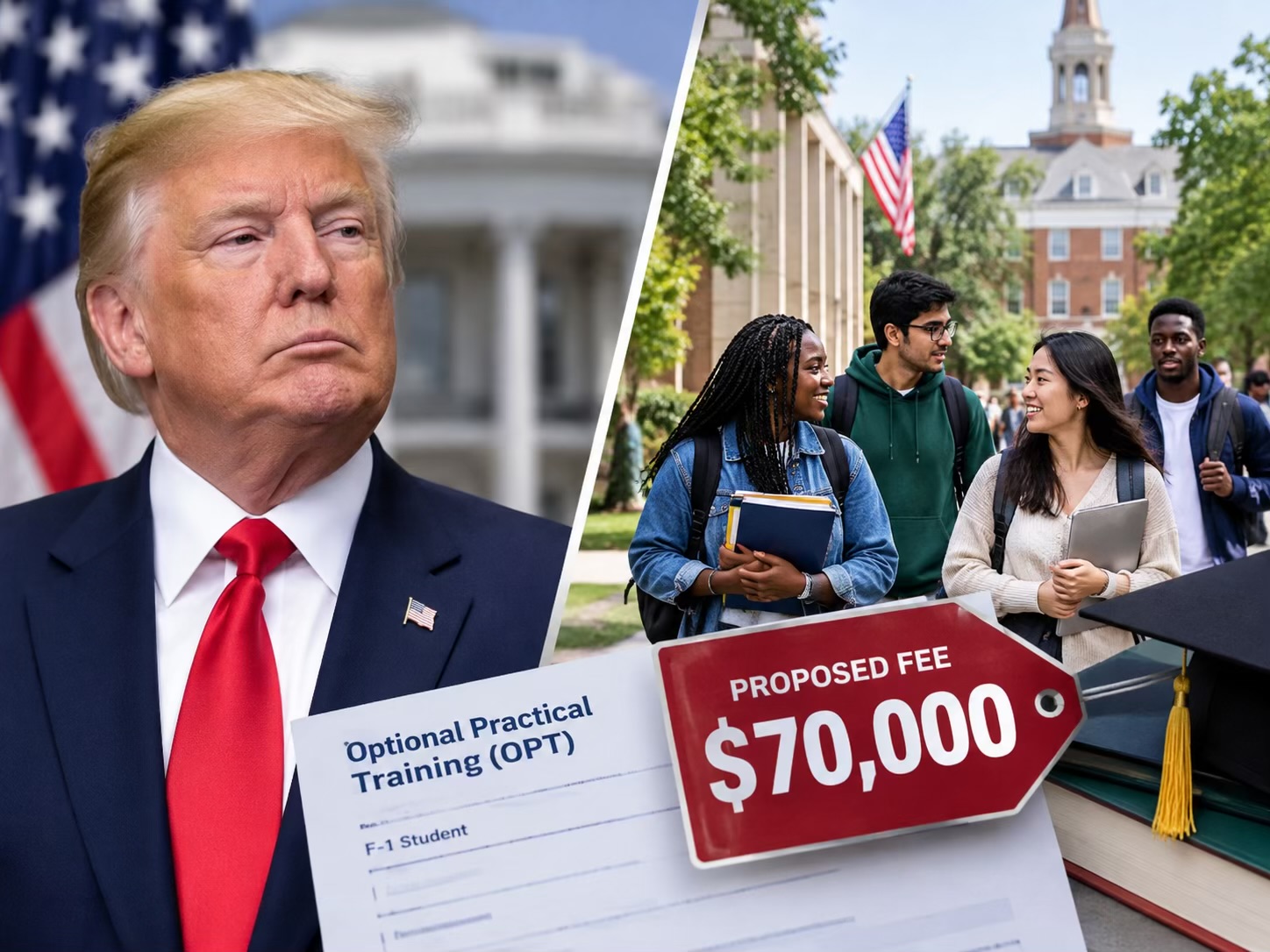
The Trump administration has proposed a $70,000 fee for US universities and other eligible institutions that recommend international students for Optional Practical Training (OPT), a move that could make it far harder for Nigerian graduates to gain work experience in the United States.
The Department of Homeland Security (DHS) also proposes a $30,000 charge for each subsequent OPT recommendation, including qualifying extensions.
The fees are proposed, not yet in force. DHS published the proposal on Wednesday as part of President Donald Trump’s wider effort to tighten immigration rules and reduce what it regards as misuse of programmes for foreign workers.
What is OPT and why does it matter?
OPT allows eligible F-1 international students to work temporarily in jobs directly related to their field of study.
Most eligible graduates can receive up to 12 months of post-completion OPT. Graduates in qualifying science, technology, engineering and mathematics (STEM) fields can apply for an additional 24 months.
That makes OPT an important bridge between studying in the US and entering the American labour market.
It can also provide graduates with professional experience while giving employers access to workers trained in the US.
The programme has grown substantially. The Institute of International Education reported 294,253 international students on OPT in the 2024/25 academic year, a 21% increase from the previous year.
Why is DHS proposing such a large fee?
DHS says OPT has expanded beyond its original purpose and has become vulnerable to fraud and abuse.
The department argues that some employers use the programme as a source of cheaper foreign labour and that the growth of OPT has allowed some students to remain in the US workforce without facing the numerical limits that apply to H-1B visas.
In its proposed rule, DHS pointed to 165,524 F-1 students participating in STEM OPT in 2024, alongside 194,554 students in pre- and post-completion OPT. It argued that STEM OPT participation had grown sharply since the programme was introduced.
A DHS spokesperson described OPT as a programme that was never intended to become “a back door into the American workforce” or a “pipeline for cheap foreign labour”.
The administration says the proposed fee would force universities to examine OPT applications more closely because institutions would have a significant financial stake in recommending students.
But who actually pays the $70,000?
This is one of the most important details missing from some early reports about the proposal.
The proposed $70,000 fee would initially be paid by the US educational institution, not directly by the international student.
However, DHS explicitly says schools would not be restricted in how they source the money. They could pass the financial obligation to the individual F-1 student, all students at the institution or employers.
That means a Nigerian graduate might not receive a government bill for $70,000.
The practical effect could nevertheless be similar if a university requires the student or prospective employer to cover some or all of the cost.
For universities, the decision could become a calculation over whether an international student’s tuition and wider economic contribution justify the additional OPT cost.
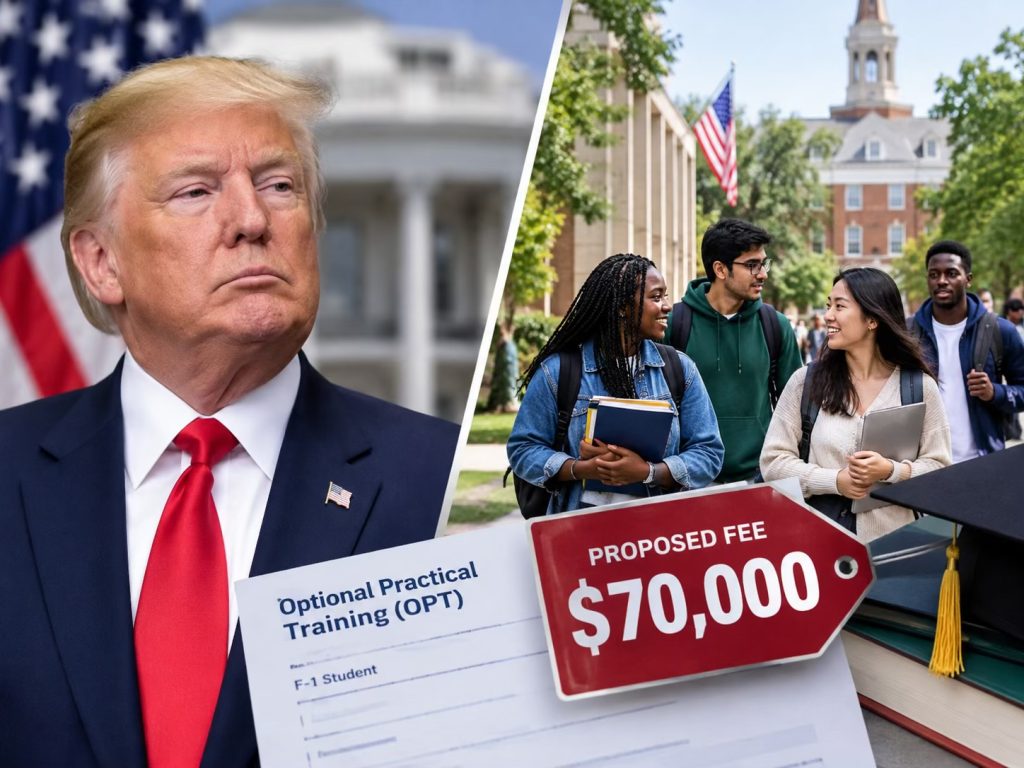
President Donald Trump on one side;
an identifiable group of international students and
a subtle visual reference to the $70,000 proposed fee. Credit: Chatgpt
Why Nigerian students could feel the impact
Nigeria is already a significant source of international students for US universities.
Open Doors data show that 21,847 Nigerians studied at US higher education institutions in the 2024/25 academic year, making Nigeria the eighth-largest source of international students to the United States. Nigerian enrolment also reached its highest level in the series reported for that year.
For a Nigerian student paying international tuition, the proposed fee could therefore affect a critical part of the decision to study in America.
A university could decide that sponsoring OPT is too expensive.
An employer could decide that hiring an international graduate is no longer financially attractive.
Or a student could face an additional charge that makes the US less affordable compared with countries offering clearer post-study work routes.
That could particularly affect students in STEM and other fields where graduates traditionally use OPT to obtain US work experience.
The potential benefit for US workers
The administration’s argument is not without a policy question behind it.
If employers genuinely use OPT to replace US workers with cheaper foreign labour, tighter oversight could protect American employees and reduce incentives for companies to exploit the programme.
DHS also argues that schools currently have limited financial incentives to scrutinise every OPT recommendation.
The proposed fee would change that calculation.
But the key question is whether a $70,000 charge is necessary to achieve that objective.
DHS could also strengthen workplace inspections, verify employer claims, improve wage monitoring and punish fraudulent employers without making legitimate participation prohibitively expensive.
The proposed rule itself acknowledges that the cost would be substantial.
The potential damage to universities and employers
American universities could face a difficult choice.
International students already contribute significantly to the US economy. NAFSA estimates that international students contributed $42.9 billion and supported 355,736 jobs during the 2024/25 academic year.
The United States also hosted nearly 1.18 million international students during that academic year.
OPT accounted for almost 294,000 of them.
A major increase in the cost of moving from study to employment could therefore affect more than individual graduates.
It could influence where prospective students choose to study, how universities recruit overseas and how technology, engineering and other industries access skilled workers.
The timing is also significant because US international student recruitment is already facing pressure.
NAFSA’s latest outlook projects further declines in international student numbers and estimates that the US could lose billions of dollars in economic contributions under current trends.
Also Read: Jude Chiemeka becomes president of African Securities Exchanges Association https://olokunsmedianetwork.com/2026/10/07/jude-chiemeka-becomes-president-of-african-securities-exchanges-association/
NAFSA rejects the proposal
Fanta Aw, CEO of NAFSA, said OPT gives international students practical experience while helping employers address labour shortages, particularly in STEM fields.
“Driving away the talents, perspectives, and aspirations of international students will only hurt American innovation, economic growth, workforce development, and global leadership,” Aw said.
Her argument is that international graduates do not necessarily compete directly with American workers.
Instead, they can fill skills gaps, contribute to research and innovation and create additional economic activity.
That claim, however, is disputed by the Trump administration, which says the programme can create unfair competition for US workers.
The debate therefore centres on a difficult policy question: does OPT primarily fill skills shortages, or does it allow employers to access foreign labour under conditions that can weaken protections for US workers?
The proposed rule does not settle that dispute.
Legal challenges could follow
The proposal could also face legal challenges if DHS moves to finalise it.
Doug Rand, a former senior adviser at US Citizenship and Immigration Services, said the proposed charge could face the courts.
“When we educate international students at our universities, and they want to work and apply their talents here after graduating, of course we should embrace them — not use an exorbitant fee as a pretext to send them packing,” Rand said.
He compared the proposal with the Trump administration’s separate attempt to impose a $100,000 fee on H-1B petitions, another policy that has faced legal challenges.
DHS, however, argues that it has legal authority to regulate the conditions attached to F-1 student status and says the fee would strengthen oversight of OPT. The proposed rule sets out several statutory grounds on which the department says it has authority to act.
Whether those arguments survive a court challenge would ultimately depend on the final rule and the legal claims brought against it.
A sharp change from Trump’s earlier message to graduates
The proposal also sits uneasily alongside an earlier position expressed by Trump during his 2024 presidential campaign.
Trump then said foreign students who graduated from US colleges should be able to receive green cards to remain and work in the country.
His campaign later clarified that the proposal would apply to highly skilled graduates after vetting.
The current proposal points in a different direction by making the transition from education to US employment potentially much more expensive.
That contrast could become an important issue for international students deciding whether the United States remains an attractive destination for higher education.
How much money could the proposal generate?
The financial scale of the proposal is enormous.
DHS estimates that the fees could generate between $8.4 billion and $16.5 billion annually, depending on participation levels, with a primary estimate of $12.4 billion.
That creates another question of public accountability.
If the policy is intended primarily to combat fraud and protect American workers, policymakers will need to demonstrate that the fee is proportionate to those objectives.
If participation falls sharply, the government could collect less money while universities lose international students and employers lose access to some graduates.
In that scenario, the policy could achieve its immigration objective but impose wider economic costs.
What happens next?
The proposal is not yet law.
The DHS notice scheduled for publication in the Federal Register provides 30 days for public comments on the proposed rule. A separate information-collection component has a 60-day comment period. DHS can change the proposal after reviewing submissions.
Universities, students, employers and advocacy organisations can use that period to challenge the cost, provide evidence about OPT’s economic impact and propose alternative safeguards.
For Nigerian students already studying in the US, the immediate message is to avoid treating the $70,000 figure as an existing charge.
The current proposal still has to pass through the rule-making process and could be amended, withdrawn or challenged in court.
For prospective Nigerian students, however, the proposal sends a clear warning: the cost and certainty of remaining in the US for post-study work may become a much more important part of choosing where to study.
The bigger test for the Trump administration will be whether it can protect American workers and prevent abuse without making the US less competitive in the global race for skilled talent.