A Canada-based Nigerian doctor, known as Doctor Zo, has urged the government to invest in automated external defibrillators (AEDs) rather than political campaign buses, following the death of gospel singer Toluwanisings.
Doctor Zo said the devices could help save lives during certain cardiac emergencies. He also called on Nigerians to reconsider selling their votes, arguing that public resources should support life-saving healthcare equipment.
His comments have added to a growing debate about emergency medical services in Nigeria following the death of Olayemi Bayonile Bolaji, popularly known as Toluwanisings, on 14 October 2026.
The singer’s death has prompted questions about access to urgent medical treatment, the state of public healthcare and the government’s responsibility to provide effective emergency services.
However, the circumstances surrounding his death remain unclear. His family has not publicly disclosed the cause of death.
Doctor Zo questions spending priorities
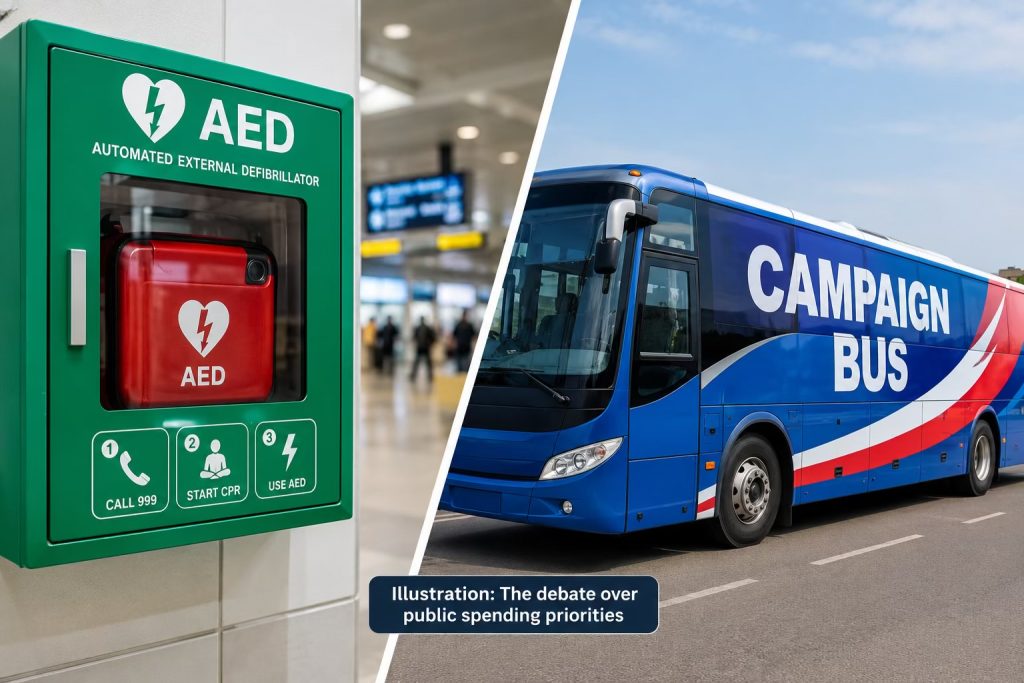
In a statement accompanying a demonstration of an AED, Doctor Zo said the government could use money spent on campaign buses to purchase the devices and distribute them across Nigeria.
“I think there is a 50–60% chance that Toluwanisings would still be alive today if he were in a country with good governance. With this Automated External Defibrillator (AED) I’m holding here, I have brought several people back to life. Each device costs over $2,000. Can our government use the money spent on campaign buses to purchase these devices and distribute them across the country? If you people like, continue selling your votes next year”
— Doctor Zo
In a second statement, the doctor proposed distributing the devices as political palliatives.
“In my opinion, Automated External Defibrillators (AEDs) should be provided as APC palliatives instead of all these buses they are sharing. Buy thousands of them and distribute them across the entire state. They are also very easy to operate.”
— Canada-based Nigerian doctor, Zo
The doctor’s remarks raise a policy question about whether governments and political parties should prioritise visible political giveaways or investments in public health.
However, the claim that Toluwanisings had a 50–60% chance of surviving in a country with better governance is his personal assessment. No publicly available medical evidence establishes that probability or confirms that an AED would have prevented the singer’s death.
Also Read: Lagos Approves Christ Divine Favour College as 100 Other Private Schools Receive Provisional Letters https://olokunsmedianetwork.com/2026/10/18/lagos-approves-christ-divine-favour-college-as-100-other-private-schools-receive-provisional-letters/
What happened before Toluwanisings died?
Toluwanisings died in the early hours of 14 October 2026, according to a statement released by his family.
His personal assistant, Babadunni Gbolabo, subsequently said efforts to obtain medical attention took them to between seven and eight hospitals in Ibadan, Oyo State.
According to reports by Premium Times, the assistant said some facilities cited a doctors’ strike, while others allegedly declined to admit the singer.
The allegations have intensified scrutiny of emergency healthcare services in the state. However, the circumstances at each facility require independent verification.
The University College Hospital, Ibadan, reportedly said it had no official record showing that the singer was brought to the facility.
The conflicting accounts make an independent investigation important. Authorities would need to establish which hospitals the singer’s team approached, whether medical personnel were available and what prevented him from receiving treatment, if the reported refusals are substantiated.
The family has not publicly confirmed the cause of death. It would therefore be premature to conclude that a cardiac arrest occurred or that an AED would have saved him.
What is an AED, and how can it save lives?
An automated external defibrillator is a portable medical device that checks a person’s heart rhythm and can deliver an electric shock when necessary.
It is designed to help treat certain life-threatening heart rhythm disturbances associated with sudden cardiac arrest.
AEDs provide spoken or visual instructions to guide users through the process. However, they do not treat every cause of collapse, and they cannot replace professional medical care.
According to established first-aid practice, a person who suddenly collapses and does not respond or breathe normally needs immediate emergency assistance.
A bystander should contact emergency services, begin cardiopulmonary resuscitation (CPR) and use an AED as soon as one is available, following the device’s instructions.
Early CPR and defibrillation can improve survival in cases of cardiac arrest caused by shockable heart rhythms.
This makes public access to AEDs potentially valuable in airports, shopping centres, stadiums, schools, workplaces and other locations where large numbers of people gather.
However, the devices cannot address every medical emergency. A person may collapse because of a stroke, severe bleeding, a blood clot or another condition that requires different treatment.
Without a confirmed cause of death, there is no basis for saying that an AED would have changed the outcome in Toluwanisings’ case.
Could Nigeria afford to distribute thousands of AEDs?
Doctor Zo said each device costs more than $2,000 and suggested that the government could buy thousands for distribution across the country.
At that quoted price, purchasing 1,000 AEDs would cost more than $2m before shipping, import duties where applicable, storage, training, maintenance and other associated expenses.
The actual cost would depend on the model, supplier, procurement arrangements and applicable charges. The doctor’s quoted price should not be treated as a verified market-wide price.
A nationwide programme would also require a plan for deciding where the devices should go and who would maintain them.
AEDs need accessible storage, regular checks and replacement of consumable components such as batteries and electrode pads when necessary.
People who work in locations where AEDs are installed should receive basic training in CPR and emergency response. Although the devices provide instructions, an effective response also depends on recognising cardiac arrest quickly and acting without delay.
The government would therefore need to budget for more than purchasing equipment.
A poorly managed distribution programme could leave expensive devices unused, inaccessible or in working environments where nobody knows how to respond to an emergency.
Conversely, a well-planned programme could improve access to early defibrillation in places where emergency medical response times are long.
Campaign buses versus healthcare spending
Doctor Zo’s proposal also raises questions about the use of public funds and the distinction between government spending and political party expenditure.
Campaign buses may be purchased by political parties, candidates, private donors or public institutions for different purposes. The source of funding matters when assessing whether the money could legally and practically be redirected to healthcare.
If a political party purchases buses using its own funds, the government cannot automatically treat that money as public revenue.
If public funds support the purchase, however, the expenditure should be assessed against the relevant budget, procurement rules and public-interest objectives.
The same scrutiny should apply to a proposed AED programme.
Rather than relying on a general appeal to redirect money from buses, policymakers would need to identify the expenditure involved, establish the available budget and explain how a healthcare programme would be funded.
They would also need to publish procurement records, distribution locations and maintenance arrangements to demonstrate that the equipment reaches the intended communities.
The proposal could provide an opportunity to improve emergency preparedness. But it should not become a political slogan without a transparent implementation plan.
What Nigerians are saying on X
Toluwanisings’ death has also triggered wider criticism of Nigeria’s healthcare system on social media.
Some users have questioned whether patients can obtain urgent treatment when hospitals face staffing shortages, industrial disputes or other operational problems.
In reactions reported by Nigerian media, an X user identified as @festbrzy recalled losing their mother in 2020 and argued that the country did not give healthcare sufficient priority.
Another user, @poga11, questioned the state of public hospitals in Ibadan and called for an investigation into the allegations surrounding the singer’s final hours.
The reactions reflect public frustration about access to emergency treatment. They do not, on their own, establish what happened at the hospitals reportedly approached by Toluwanisings’ team.
The controversy has also exposed a difficult question about responsibility during medical emergencies.
Healthcare workers have professional duties to patients, but their ability to provide treatment also depends on staffing, equipment, working conditions and the availability of functioning medical facilities.
An investigation should establish the facts rather than assign blame based solely on social media accounts.
Note: These reactions are attributed to accounts cited in published reports. Their original X posts should be checked before publication, and additional posts should not be quoted without verifying the accounts, wording and context.
The limits of an AED-only solution
Doctor Zo’s proposal highlights one potentially useful intervention, but Nigeria’s emergency healthcare challenges extend beyond the availability of defibrillators.
An AED cannot help a patient if nobody recognises the emergency, the device is too far away or the patient cannot reach a facility for further treatment.
Even when bystanders respond correctly, patients may still need an ambulance, emergency doctors, oxygen, medicines and specialised treatment.
The allegations surrounding Toluwanisings’ final hours also raise questions about hospital readiness and the coordination of emergency referrals.
Authorities should establish whether the facilities contacted had the capacity to provide immediate care and whether any barriers delayed treatment.
They should also examine the effect of industrial disputes on emergency services and clarify what arrangements exist to protect patients who need urgent treatment during strikes.
Hospitals, governments and medical associations have different responsibilities, and the available evidence should determine how those responsibilities are assessed.
A credible response would combine access to life-saving equipment with better emergency coordination, trained responders and reliable hospital services.
What should happen next?
The first step is to establish the circumstances surrounding Toluwanisings’ death.
Relevant authorities should investigate the reported hospital visits, verify the claims made by his personal assistant and clarify the role, if any, that delays in accessing treatment played in the outcome.
The government should also assess the availability of AEDs in public places and emergency facilities, alongside the number of trained responders and the readiness of ambulance services.
A pilot AED programme could begin in carefully selected high-traffic locations, supported by staff training, maintenance arrangements and public reporting on how the devices are used.
Officials could then assess the programme’s effectiveness before expanding it to more communities.
The government should publish the cost per device, the procurement process, the locations selected and the agency responsible for maintenance.
Political parties and public institutions should also explain how they fund vehicles and other public-facing initiatives, particularly when their spending attracts questions about competing public needs.
Doctor Zo’s proposal has drawn attention to the potential value of AEDs, but the larger test is whether the debate leads to measurable improvements in emergency care.
For Nigerians, the central issue is not simply whether governments buy defibrillators instead of buses. It is whether people who suffer life-threatening medical emergencies can obtain timely, appropriate treatment, wherever they live.