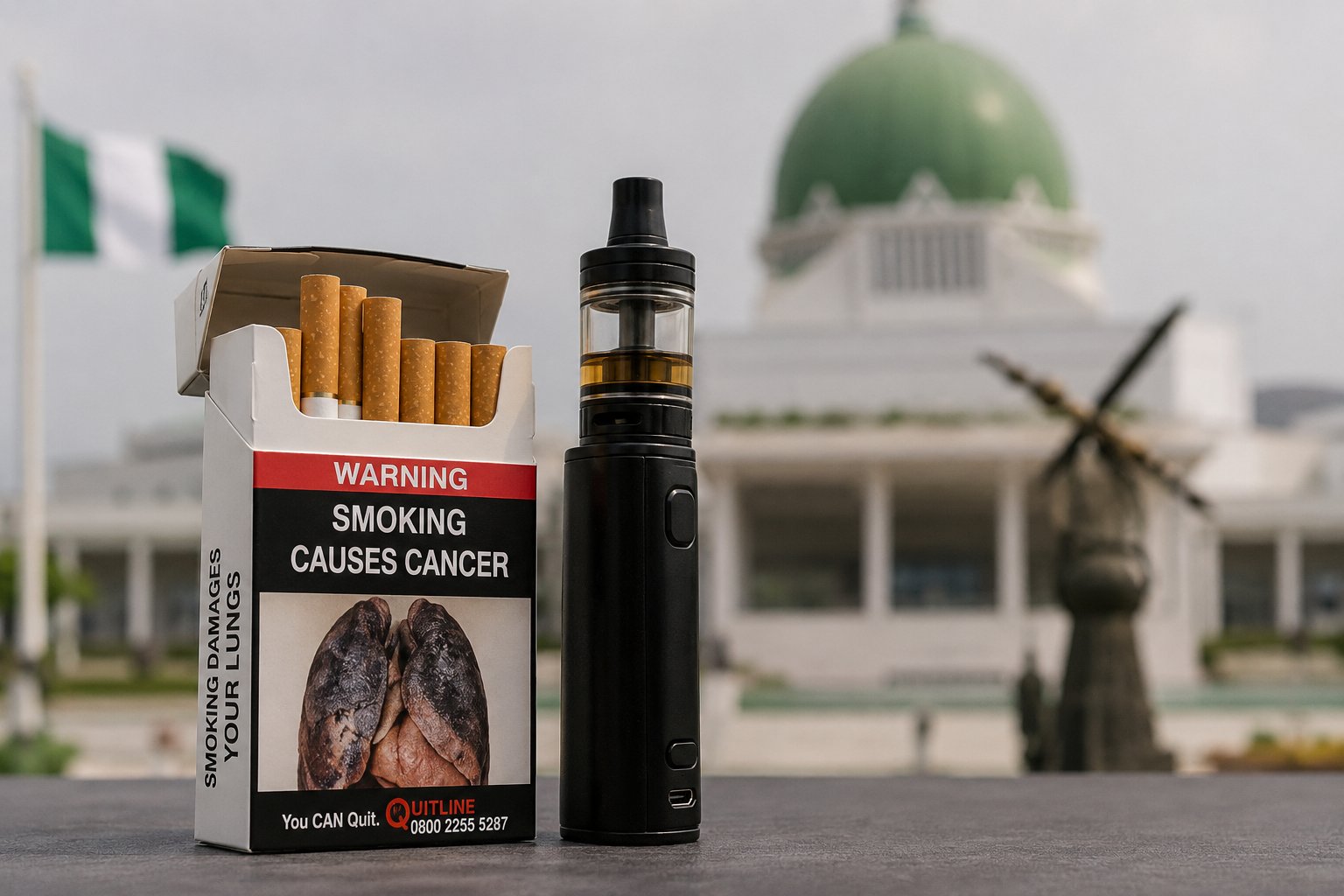

Three civil society organisations have asked President Bola Ahmed Tinubu not to sign the National Tobacco Control Act (Amendment) Bill 2025, arguing that proposed changes could weaken restrictions on tobacco and nicotine products.
The Renevlyn Development Initiative (RDI), Initiative for Community Development and Advancement of Social Orientation (ICODASO) and Cedars Refuge Foundation made the request in a letter dated 19 August 2026.
The groups want the president to return the legislation to the National Assembly and subject the proposed changes to wider public scrutiny.
They argue that some provisions would relax restrictions on advertising, promotion and sales of tobacco and alternative nicotine products.
What is being proposed?
The organisations say the amendment would allow forms of marketing that are currently tightly restricted, including online marketing, point-of-sale displays, remote sales and event sponsorships involving non-combustible and alternative nicotine products.
They are particularly concerned about products such as vapes, e-cigarettes and nicotine pouches.
However, the groups' characterisation of the proposed changes could not independently be verified from the text of the bill made available with their statement.
The National Assembly should therefore publish the full amendment and the relevant clauses for public scrutiny before claims about its precise effects can be assessed.
The groups also object to what they describe as a proposed change to the definition of tobacco products.
They said the amendment would remove some non-combustible nicotine products from the principal tobacco definitions and criticised the use of "harm reduction" in relation to the products.
The organisations described "harm reduction" as "an industry spin word", but that is their characterisation rather than an independently established fact.
Why are the groups concerned?
The organisations argue that weaker advertising and sales restrictions could increase young people's exposure to nicotine products.
There is evidence behind some of that concern. The World Health Organization says nicotine is highly addictive and that e-cigarettes can expose users to toxic substances. It also says young people who use e-cigarettes are nearly three times more likely to take up conventional cigarettes.
WHO has also warned that tobacco and nicotine companies use social media, flavours, product design and other marketing techniques to attract young people.But the evidence does not support treating every alternative nicotine product as identical.
The health risks, nicotine content and potential role in smoking cessation differ between products, while the long-term effects of some newer products remain uncertain.
WHO itself says countries that permit e-cigarettes should regulate them strongly and that governments considering their use for smoking cessation should weigh the potential risks against established cessation methods.
Nigeria's tobacco-control rulesNigeria's current tobacco-control framework dates largely from the National Tobacco Control Act 2015 and the National Tobacco Control Regulations 2019.
The 2019 regulations provide the framework for implementing the 2015 Act and aim to protect people's health and reduce exposure to tobacco smoke.
Nigeria ratified the WHO Framework Convention on Tobacco Control in 2005 and later enacted the 2015 law covering areas including advertising, packaging and smoke-free environments.
The federal government has also adopted a National Tobacco Control Strategic Plan of Action for 2024-2028, alongside communication and enforcement plans covering the same period.
That means the proposed amendment comes while Nigeria is still working to implement and enforce its existing tobacco-control framework.
WHO recognition raises the stakes
The groups' concerns also come months after the National Film and Video Censors Board (NFVCB) received the WHO Director-General's Special Award for the African Region for its tobacco-control work in entertainment media.
WHO says the NFVCB introduced regulations in 2024 prohibiting the promotion and glamorisation of tobacco and nicotine products in films, music videos and skits, particularly where young audiences could be exposed.
The award was announced ahead of World No Tobacco Day in May 2026. The NFVCB was the only Nigerian institution among the African recipients.
The three organisations argue that loosening restrictions elsewhere could undermine some of those gains.
That claim requires careful scrutiny, however. An international award for one regulatory measure does not by itself establish that every proposed amendment would weaken Nigeria's overall tobacco-control system.
What do the groups want?
RDI Executive Director Philip Jakpor, ICODASO Executive Director Okeke Anya and Cedars Refuge Foundation Executive Director Peter Unekwu signed the letter.They urged President Tinubu not to assent to what they described as "anti-public health amendments".
Instead, they want the National Assembly to reopen the amendment process to public participation.
They said: "The amendments proposed by the promoters of the Bill, if passed into law, will roll back the gains that Nigeria has made since the NTC Act 2015 and its Regulations in 2019 became law.
"They also said: "There is no time than now to listen to the voice of Nigerians that are united in the conviction that the provisions in the amended bill would weaken communities, and leave the national economy vulnerable due to untimely deaths that would follow."
The groups did not provide economic modelling in the letter to quantify the potential cost of the proposed changes.
That matters because tobacco policy involves competing considerations, including public health, consumer access, taxation, enforcement, illicit trade and the commercial interests of manufacturers and retailers.
What happens next?
The immediate question is whether President Tinubu will assent to the bill, withhold assent or seek further consideration of its provisions.
The National Assembly could also face pressure to publish the amendment's full text and provide evidence supporting the proposed changes.
For the public, particularly parents and young people, the central issue is whether the final legislation will tighten or loosen access to tobacco and nicotine products and how effectively the government will enforce whichever rules emerge.The debate is therefore not simply about whether Nigeria should regulate tobacco.
It is about how far those controls should extend to newer nicotine products and whether changes to the law will protect public health without creating unintended consequences.