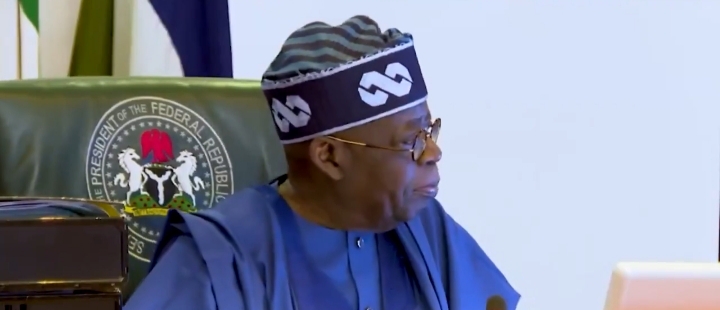

President Bola Tinubu has ordered the Economic and Financial Crimes Commission (EFCC) to return to court and seek the withdrawal of an order freezing an Osun State Government account, just days before the state's governorship election.
The President said the EFCC obtained the order on 5 August but described the timing as inappropriate because Osun voters are due to elect their governor on 15 August.
Mr Tinubu said his intervention was intended to protect confidence in the electoral process, rather than prevent the EFCC from investigating suspected financial wrongdoing.“Osun State is only a few days away from its gubernatorial election.
Therefore, nothing ought to be done to give an impression that the EFCC or indeed any other agency of the federal government is being used to interfere with the election.”
He directed the commission to:“immediately proceed to the court to vacate the order and discontinue whatever action it has instituted against the Osun State Government in this regard.”
Adeleke disputes EFCC account
Governor Ademola Adeleke had earlier given a different account of the incident.He said his administration received a letter from its bank informing it that the EFCC had ordered the restriction of the state government's account.
Mr Adeleke said:“This action was taken without any court order.”The governor described the action as unlawful and said he had instructed the state's Attorney-General to challenge it at the Federal High Court in Osogbo.
He also called on the EFCC chairman to explain the reason for the restriction.“All I ask is for the efcc chairman to explain to the good people of Osun State and to Nigerians in general, why he froze Osun State Government Account, and show proof to support whatever reason, he presents.”The two accounts create a significant factual question.
President Tinubu says the EFCC obtained a court order on 5 August, while Governor Adeleke says the account was frozen without one.
The actual court order, the EFCC's application and the bank's restriction notice would help establish exactly what happened.
Why the timing matters
The account freeze occurred during the final stages of the Osun governorship election campaign.
The election is scheduled for 15 August.
The timing alone does not prove that the EFCC was acting for political reasons.
However, restricting a state government's account so close to an election raises legitimate questions about whether the action could affect the government's ability to operate and whether it could influence public perceptions of the electoral process.
President Tinubu said he was concerned about precisely that perception.He said:“I must state that I feel deeply embarrassed not by the EFCC's exercise of its mandate backed by a court order, but by the timing of the agency's action.”
Legal view: Was Tinubu right to intervene?
The President's decision has itself become part of the controversy.
Senior Advocate of Nigeria Oba Maduabuchi, speaking on Arise News, argued that the circumstances of the election justified the President's intervention.
He said the concern was not necessarily the EFCC's power to investigate but the timing of the restriction.
According to Maduabuchi, the account should be unfrozen until after the election, after which the EFCC could continue its work if it had grounds to do so.
He questioned whether allowing the restriction to remain in place during the election period would create the wrong public perception.
During the interview, he said the President's intervention did not necessarily mean the EFCC was not independent.
He argued that, given the circumstances, the President had a responsibility to prevent federal institutions from taking actions that could be perceived as affecting the electoral process.
However, the lawyer's position is an opinion on the constitutional and institutional question, not a judicial determination that the President's directive was legally valid.
The issue could become more complicated if the EFCC had already obtained a valid court order and the President was directing the agency to discontinue the matter.
The courts, rather than political actors, would ultimately determine the legal implications.
Accord Party raises broader concerns
Victor Akande, chairman of the Accord Party in Osun State, also discussed the controversy on Arise News.
Mr Akande argued that federal institutions operate under the authority of the President and said the timing of the EFCC's action could damage Nigeria's image and create the perception of a threat to democracy.
He said:“All these institutions are under the radar of the President of the Federal Government.”
Mr Akande said the timing of the EFCC action was particularly troubling because of the election.
“What the EFCC did yesterday put the country in a bad image, and it seems it's a threat to democracy because of the timing of the action.”
He supported the President's intervention, arguing that it did not necessarily amount to interference with the EFCC's independence.
“So, I don't see anything wrong with the statement of Mr. President, and that doesn't mean that the EFCC is not independent.”
Mr Akande said the President was responding to the circumstances surrounding the election rather than stopping the EFCC from investigating.
His argument was that the restriction could be removed temporarily and the commission could resume its work after the election.
“He said the way you did it is wrong. Remove it now, after the elections, go back and continue your work.”
Mr Akande's comments represent the position of an opposition political party in Osun and should therefore be read in that political context.
Tinubu defends agency independence
The President said he had deliberately avoided interfering with the operational activities of anti-corruption agencies.
“Since assuming office, I have consistently maintained that anti-corruption and law enforcement agencies must be allowed to discharge their statutory responsibilities independently, professionally, without fear or favour, or political interference.
”He said institutions should be allowed to perform their duties within the powers given to them by law.
His decision to intervene in the Osun case therefore raises a separate question about where the boundary lies between presidential responsibility and the operational independence of the EFCC.
The President has not said that the commission must abandon any wider investigation into Osun State.
Instead, he has directed it to withdraw the particular account-freezing action.
What happens next?
The EFCC is expected to return to court to seek the withdrawal of the order, following the President's directive.
Governor Adeleke has also indicated that his administration will challenge the action legally.
The immediate issue is whether the account will be unfrozen before the election and whether the state's government operations have been affected.
The wider question is whether the EFCC's underlying investigation will continue after the election.
For voters, the issue is not simply a political dispute between Abuja and Osun.
It is whether public institutions can investigate suspected financial wrongdoing while ensuring that their actions do not undermine confidence in an election.
The answers are likely to depend less on competing political statements and more on the court documents and financial evidence behind the EFCC's action.
Related: Why Did EFCC Freeze Osun Account? What We Know About the ₦11bn Investigation