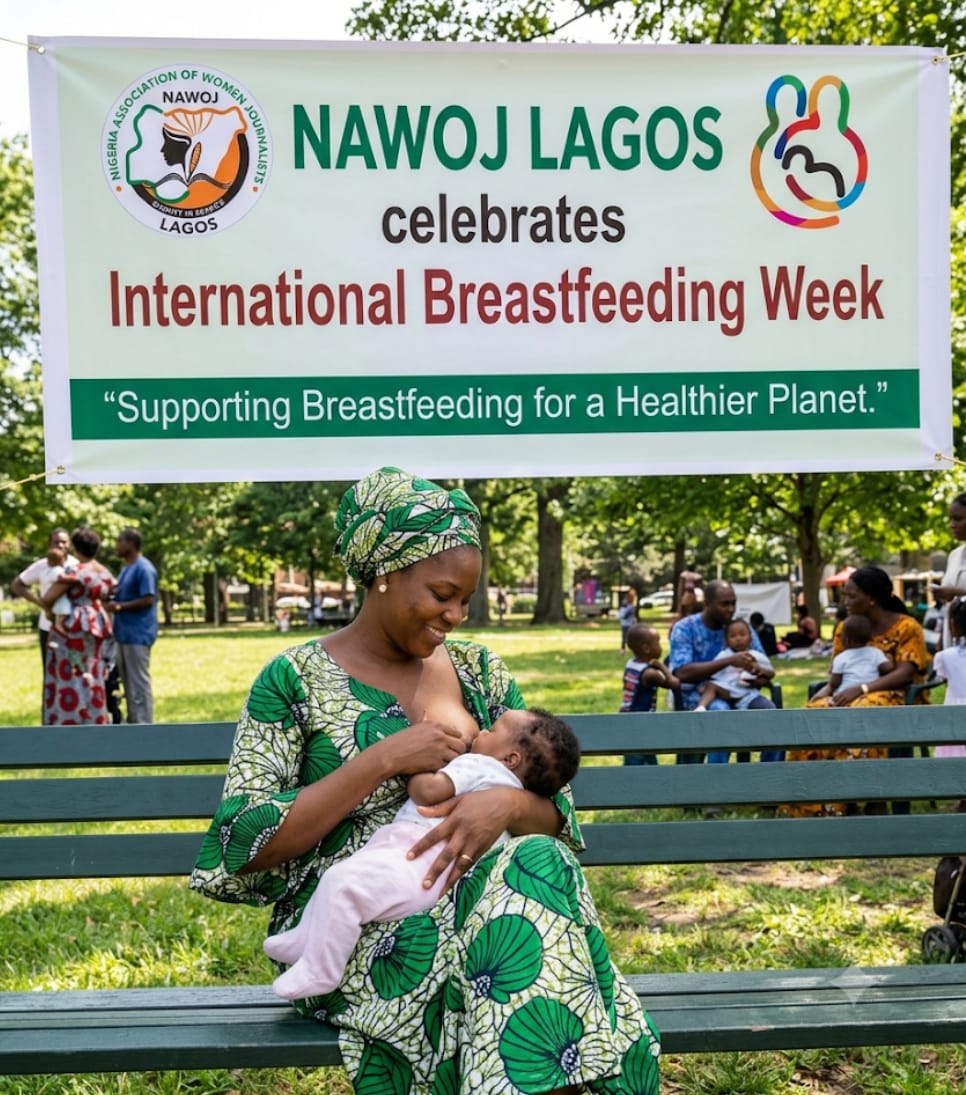

The Nigeria Association of Women Journalists (NAWOJ), Lagos State chapter, has designated August as a maternal nourishment and holistic health awareness month, as new national data show that fewer than one in three Nigerian infants are exclusively breastfed for their first six months.
NAWOJ Lagos says it will use its media platforms throughout August to draw attention to maternal nutrition, breastfeeding support and the role families and healthcare providers play in helping mothers care for their babies.
The announcement comes as Nigeria continues to struggle to improve breastfeeding practices.
Data from the 2024 Nigeria Demographic and Health Survey (NDHS) put the proportion of infants exclusively breastfed for the first six months at 29%.
UNICEF says the figure has stagnated despite repeated efforts to improve infant feeding.
That means the central issue is not simply whether Nigerian mothers breastfeed, but whether they receive enough support to breastfeed exclusively for the recommended six months.
WHO and UNICEF recommend exclusive breastfeeding for the first six months, followed by appropriate complementary foods while breastfeeding continues up to two years or beyond.
NAWOJ changes focus from awareness to support
Jumoke Falayi Johnson, chairperson of NAWOJ Lagos, said the organisation would use August to maintain public discussion around the health of breastfeeding mothers.
"To maintain an ongoing dialogue throughout the season, NAWOJ Lagos designates August as the 'NAWOJ Lagos Breastfeeding Awareness Month'," she said.
The association says it plans to publish original reports, expert commentary and educational features across broadcast, print and digital platforms.
Johnson said the campaign would focus on the needs of mothers as well as their babies.
"A mother cannot sustain her child's health if her own body lacks basic nutrients and rest.
Real support requires that families and neighborhood health centers actively look after the mother’s diet, peace of mind, and physical strength.
Breastfeeding should be a shared effort within the home, not an isolating burden."
The emphasis is important because breastfeeding support extends beyond telling women what to do.
WHO says effective support can include skilled counselling from health workers, supportive workplaces, maternity protection, community support and policies that enable women to breastfeed.
A problem bigger than maternal diet
NAWOJ Lagos places considerable emphasis on mothers having access to nutritious local food, adequate rest and family assistance.
But evidence suggests that improving breastfeeding rates requires a wider support system.
UNICEF's analysis of the 2023-24 NDHS found that early initiation of breastfeeding had fallen from 42% in 2018 to 36% in 2023, while exclusive breastfeeding remained at 29%.
Only 23% of children were being breastfed up to the recommended two years.
The figures raise a question for policymakers and communities: if most Nigerian mothers begin breastfeeding, why do relatively few maintain exclusive breastfeeding for six months?
Cost of food may be one factor, but it is not the only one.
Work, inadequate maternity protection, limited access to trained breastfeeding counsellors, household responsibilities and the quality of support available after mothers leave health facilities can all influence whether recommended breastfeeding practices are sustained.
WHO's current evidence also points to workplace and maternity protections as important interventions.
A WHO review of 35 studies from low- and middle-income countries found that paid maternity leave was associated with a 52% increase in exclusive breastfeeding.
Nigeria has made promises before
The Federal Government has previously acknowledged that breastfeeding requires more than individual behaviour.
In 2025, the Ministry of Health said the government was supporting breastfeeding through measures including healthcare-worker training, baby-friendly hospital initiatives, 112 days of paid maternity leave for federal civil servants and two hours of daily breastfeeding breaks until a child turns one.
But implementation remains a crucial question.
UNICEF reported that only 12 of Nigeria's 36 states and the Federal Capital Territory had paid maternity leave of up to six months at the time of its 2025 assessment.
That matters because the recommended period of exclusive breastfeeding is six months, while many mothers return to work considerably earlier.
The gap between policy commitments and the realities faced by working mothers is therefore an important part of the breastfeeding debate.
NAWOJ Lagos says its campaign is aligned with the global World Breastfeeding Week theme "Breastfeeding for a Sustainable Start in Life: Strengthen What Works".
The distinction matters because the 2026 campaign is explicitly focused on identifying interventions that work, measuring their impact and scaling sustainable support systems.
WHO and UNICEF have also highlighted the need for greater investment in breastfeeding support.