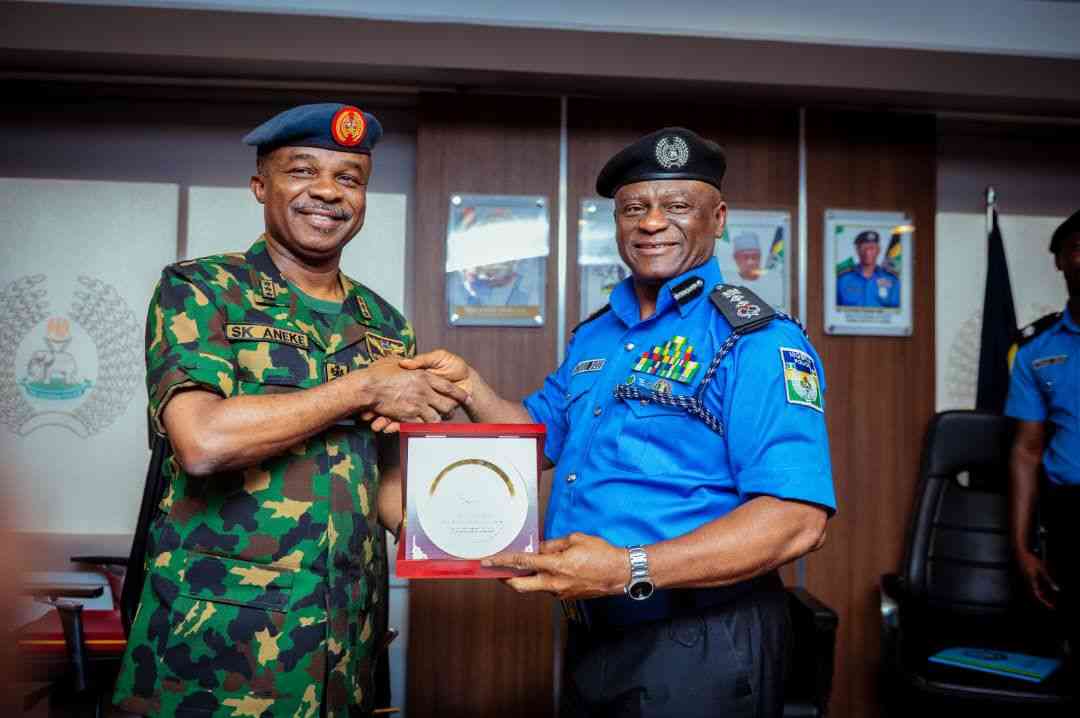

The Nigeria Police Force and the Nigerian Air Force are seeking closer operational cooperation, including greater use of aerial surveillance and intelligence sharing, as Nigeria prepares for the 2027 general elections.
The move followed a meeting between Inspector-General of Police Olatunji Rilwan Disu and Chief of the Air Staff Air Marshal S.K. Aneke at the Police Force Headquarters in Abuja on Wednesday, 2 September.
The two agencies discussed aerial reconnaissance, tactical deployment, medical evacuation, joint training and coordination during security operations, according to the police.
The discussions come as security agencies continue to confront terrorism in the north-east, banditry and kidnapping in the north-west and north-central regions, and other forms of violent crime across the country.
Why the meeting matters
The police are responsible for internal security and will play a central role in securing the 2027 elections.
The Independent National Electoral Commission (INEC) has already stressed that security agencies must begin early planning because voters, electoral officials and election materials need protection throughout the electoral process.
The Nigeria Police Force has also announced plans for a September conference where senior officers will develop a security road-map for the 2027 elections, with intelligence-led policing, technology and artificial intelligence among the issues to be considered.
The latest police-NAF discussions therefore form part of a broader effort to prepare for the next general election rather than a standalone security initiative.
What the police and Air Force want to change
Air Marshal Aneke called for sustained cooperation between the two institutions, particularly in joint operations, intelligence sharing and air support for police activities.
The meeting also examined how aircraft and other air capabilities could support surveillance and reconnaissance, tactical deployments and medical evacuation.
The Nigerian Air Force already has a formal role in intelligence, surveillance and reconnaissance, air support and strategic and tactical airlift.
The Defence Ministry describes the Air Force as the air component of Nigeria's armed forces.
The Police Air Wing has also used aerial surveillance in policing operations.In Lagos, for example, the police Air Wing worked with the Lagos State Security Trust Fund on aerial patrols in 2026 to provide situational awareness and support intelligence-led operations.
That experience suggests that the challenge is not simply putting more aircraft in the air.
The effectiveness of such operations will depend on whether information gathered from the air reaches officers on the ground quickly enough to support arrests, rescue operations or the protection of vulnerable communities.
Also Read: NDLEA Targets Drug Cartels’ Finances as Marwa Orders Asset Tracing
Security pressures remain high
The need for better coordination comes against a difficult security backdrop.
A recent report cited by the Associated Press estimated that 7,825 people were abducted in Nigeria between July 2025 and June 2026, while kidnappers collected more than $5.8m in ransom payments.
In August, a mass abduction in Niger State also highlighted the continuing ability of armed groups to operate across difficult terrain and target large groups of civilians. Reuters reported that about 600 people were abducted from a mosque, although authorities were still working to verify the exact number.
The Federal Government has meanwhile said security agencies are conducting joint intelligence gathering, aerial surveillance and search-and-rescue operations against threats in several parts of the country.
These developments show why closer cooperation between agencies could matter to communities beyond the election period.
A partnership already in progress
The latest meeting is not the first commitment by the police and Air Force to improve cooperation under IGP Disu and Air Marshal Aneke.
In March 2026, Aneke received Disu at NAF Headquarters in Abuja and reaffirmed the Air Force's commitment to closer collaboration with the police in counter-terrorism, counter-insurgency, anti-banditry and anti-kidnapping operations.
In July, Aneke also argued that Nigeria's security challenges required intelligence-led operations, stronger joint-force integration and effective use of air power.
The latest meeting therefore raises an important accountability question: what concrete improvements will Nigerians see from these repeated commitments?
For residents in areas affected by kidnapping and armed violence, the value of inter-agency meetings will ultimately be measured by faster responses, successful rescues, fewer attacks and better protection of communities.

Election security will be a major test
The police have already tested aspects of their election-security structure during the 2026 Ekiti and Osun governorship elections.
For the Osun election, the Force deployed senior officers to coordinate security operations and said it was working with other agencies under the Inter-Agency Consultative Committee on Election Security.
The police have also made clear that election security should remain the responsibility of constitutionally recognised security agencies and have warned non-state groups against taking on election-security duties.
INEC's own guidance says security agents should protect polling and collation centres and ensure that voting, counting and the declaration of results take place without disturbance.
For the 2027 polls, aerial surveillance could help security commanders identify emerging threats, monitor difficult-to-access areas and improve response times. But its use will also require clear rules, reliable intelligence and effective coordination with officers operating on the ground.
What happens next?
The police and Air Force have not announced a specific new aircraft deployment, operational timetable or additional funding arising from Wednesday's meeting.
Instead, the agencies have identified areas for closer cooperation, including joint training, intelligence sharing, air support and operational planning.
The next test will be whether those commitments produce measurable improvements before and during the 2027 elections.
For Nigerians, particularly those living in areas affected by insecurity, the key issue is not how many meetings security chiefs hold, but whether better coordination translates into safer communities and a more secure electoral process.